

MOTEK screening buckets empower pipeline backfilling projects
Release time: 2026-09-30
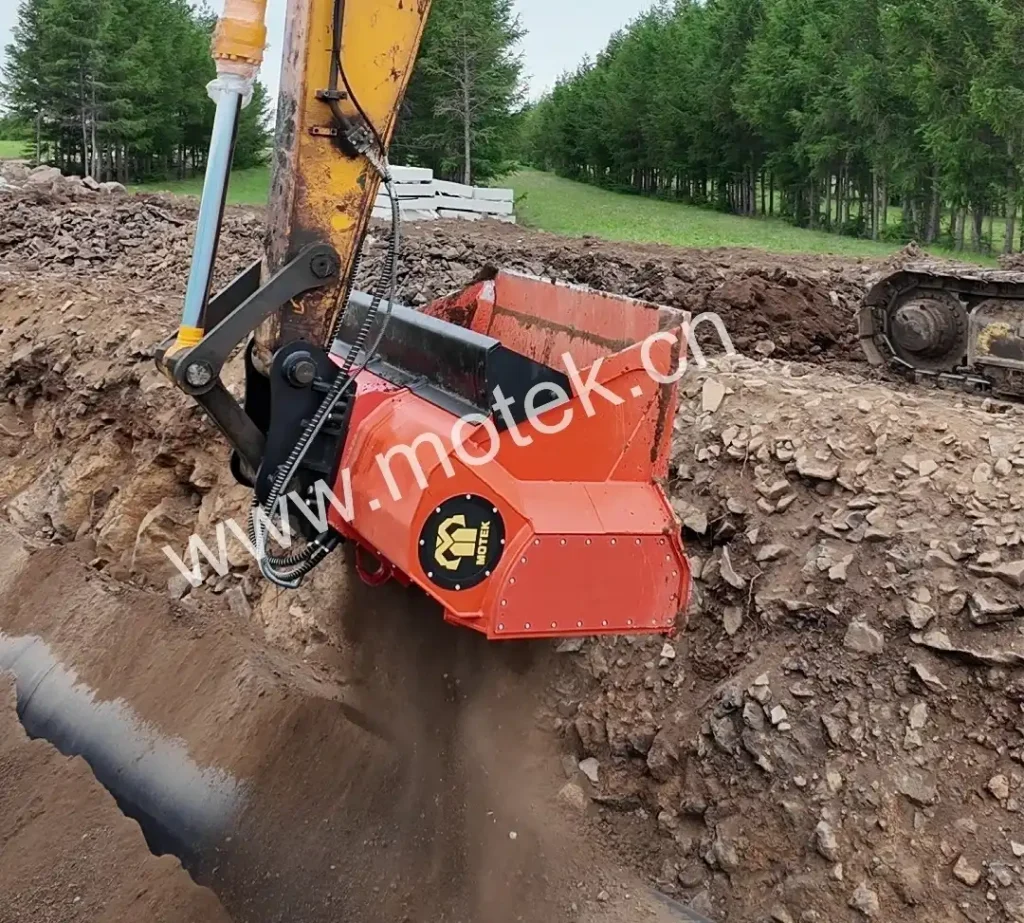
Table of Contents
In the construction of various pipeline projects—such as municipal utility networks, oil and gas transmission lines, and water supply or heating systems—trench backfilling is a critical process that determines the project’s quality, service life, and construction schedule. Backfilling operations are subject to rigorous industry standards; the fine backfill soil must be free of impurities such as large stones, construction debris, and hard soil clods. Strict control over particle size is essential to prevent sharp, hard objects from scratching the pipeline’s anti-corrosion coating or causing structural issues like deformation, settlement, and damage. These factors directly impact the safe, stable operation of the entire pipeline and its long-term maintenance costs.
For a long time, traditional rotary screening buckets have been the standard choice for soil screening in most pipeline backfilling projects. However, practical application has exposed significant drawbacks: low rotational speeds, poor material throughput, a tendency for the mesh to clog or jam, and limited adaptability to varying soil moisture levels. These issues not only result in low operational efficiency and severe project delays but also lead to incomplete screening and substandard particle sizes. Consequently, they trigger a cascade of costs—including rework, wasted labor and consumables, and schedule overruns—thereby becoming a critical bottleneck hindering quality improvement and efficiency gains in pipeline backfilling operations.
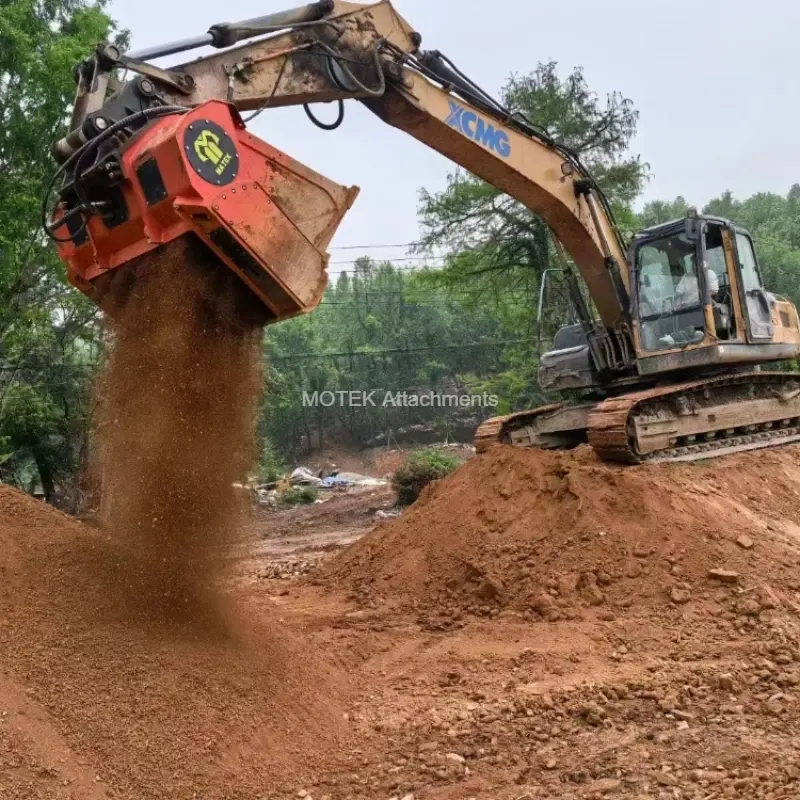
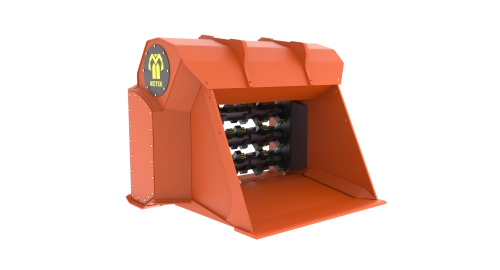
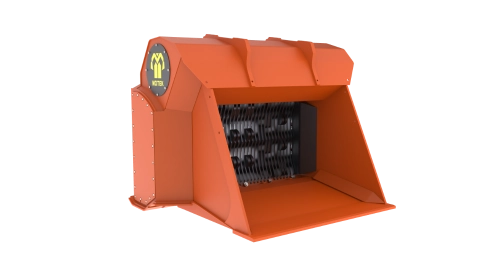
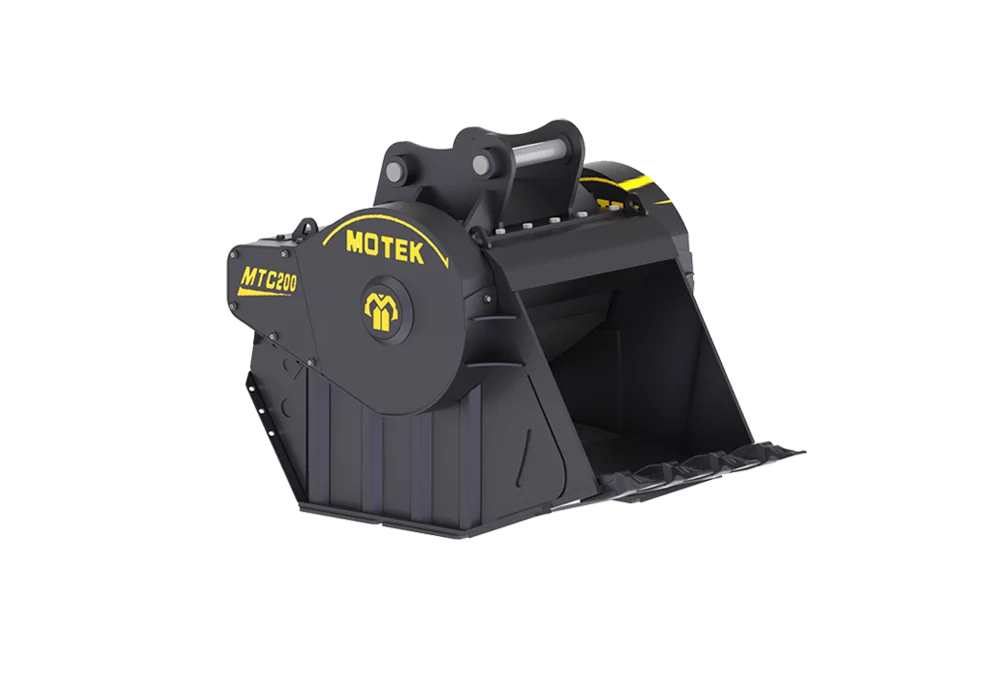
Addressing the industry’s pain points and the need for precision in pipeline backfilling, MOTEK has leveraged its deep expertise in engineering attachments to launch a significantly upgraded, professional-grade screening bucket. Tailor-made for pipeline backfill applications—including soil screening, debris separation, and on-site material processing—this equipment delivers more than triple the overall operational efficiency of traditional rotary screening buckets. It achieves comprehensive breakthroughs in screening precision, adaptability to working conditions, energy efficiency, durability, and cost savings, thereby revolutionizing traditional pipeline backfilling methods and serving as a key tool for high-efficiency construction in modern pipeline network projects.
I. Addressing Industry Pain Points: Operational Limitations of Traditional Rotary Screening Buckets
Pipeline backfilling operations are characterized by complex working conditions, mixed materials, stringent standards, and tight schedules, placing extremely high demands on the throughput, stability, and adaptability of screening equipment. Constrained by outdated structural designs and power configurations, traditional rotary screening buckets are entirely unsuited to the requirements of modern pipeline construction, exhibiting particularly glaring shortcomings.
First, operational efficiency is extremely low, and production capacity is severely insufficient. Traditional rotary screening buckets utilize a low-speed rotating drum mechanism, relying on the drum’s rotation to slowly tumble and sift material through the mesh; this results in limited batch sizes and a slow screening pace. When handling the mixed excavated soil, wet clay, and sand-gravel mixtures commonly found at pipeline construction sites, the material tends to adhere to the mesh and clog the apertures. This necessitates frequent shutdowns for cleaning and manual clearing, drastically reducing actual operating time. Extensive field measurements indicate that the daily screening output of traditional rotary buckets is limited; for large-to-medium-scale pipeline network projects or long-distance backfilling operations, they are wholly inadequate for meeting construction schedules, frequently leading to project delays.
Another issue is insufficient screening precision, which makes it difficult to guarantee construction quality. Traditional equipment often suffers from uneven drum rotation speeds and limited screening travel, preventing the thorough separation of large crushed stones and hard soil clods; consequently, materials exceeding the specified particle size limits frequently end up in the backfill. However, gas, water supply, and oil/gas pipelines are subject to strict regulations regarding the particle size of backfill soil. Sharp crushed stones can easily puncture pipeline anti-corrosion coatings, while subsequent soil settlement can cause localized deformation, leakage, or damage due to pressure. These issues not only create safety hazards but also necessitate extensive rework, significantly driving up construction costs.
II. Comprehensive Innovation: Core Advantages of the MOTEK Screening Bucket—Efficiency That Outperforms Traditional Equipment
MOTEK screening buckets precisely address the pain points encountered across the full spectrum of pipeline backfilling operations. By overcoming the structural limitations and technical bottlenecks of traditional rotary screening buckets—and through comprehensive upgrades to the power system, screening structure, materials and manufacturing processes, and operational logic—they deliver multiple advantages: a threefold increase in operational efficiency, screening precision that fully meets standards, adaptability to all working conditions, and low maintenance costs. They are perfectly suited for a wide range of pipeline backfilling projects, including municipal utility networks, long-distance oil and gas pipelines, water and heating infrastructure, and the renovation of aging pipeline networks.
. A leap in efficiency, with an overall production capacity more than three times that of traditional equipment.
Efficiency is the core competitive advantage of the MOTEK screening bucket. Equipped with a custom high-speed hydraulic power system, the unit delivers robust and stable power output, with screening speeds and material feed rates far exceeding those of traditional rotary designs. This enables a significantly larger intake per load and a markedly higher material throughput, effectively eliminating issues such as unproductive idling and inefficient operation.
. Conduct meticulous screening, strictly control backfilling standards, and eliminate potential engineering hazards.
The core requirement of pipeline backfilling projects is ensuring the purity and compliant particle size of the backfill material. MOTEK screening buckets allow for the rapid swapping of rollers with specifications such as 20mm, 30mm, and 50mm to meet the fine-soil backfill standards for various pipeline types—including gas, water supply, oil and gas, and district heating. They effectively separate out unsuitable materials—such as large stones, hard soil clods, construction debris, and other foreign objects—producing fine soil with uniform particle size and exceptional purity that fully complies with national specifications for pipeline backfilling.
Unlike traditional rotary screening buckets, which often suffer from incomplete screening and residual impurities, MOTEK screening buckets achieve a screening pass rate of nearly 100%. By eliminating at the source such quality issues as pipeline scratches caused by hard objects, uneven backfill settlement, and pipeline deformation or leakage, they significantly reduce the need for rework and lower long-term maintenance costs, thereby laying a solid foundation for the safe, long-term operation of pipeline projects.
. Adaptable to all operating conditions; suitable for both dry and wet materials; ensures stable operation on complex sites.
Pipeline construction sites often feature complex and variable soil conditions—ranging from dry, hard virgin soil and damp clay to mixed sand-gravel and shallow-layer miscellaneous fill—placing high demands on equipment adaptability. MOTEK screening buckets feature an optimized screening structure that overcomes the limitations of traditional equipment—which often struggles with moisture, stickiness, and debris—enabling seamless handling of diverse materials such as dry, wet, and cohesive soils, as well as mixed sand and gravel. Whether operating on dry open ground, damp sites following rainfall, or in mixed-soil environments typical of urban and rural utility network renovations, the equipment ensures continuous, stable performance without clogging, jamming, or downtime caused by malfunctions.
The equipment is compatible with mainstream excavators of various tonnages and offers easy installation and flexible operation. It adapts to diverse construction environments—such as narrow pipe trenches, open-field sites, and restricted urban municipal areas—without requiring site modifications or large-scale auxiliary screening equipment. This enables true on-site excavation, screening, and backfilling, thereby streamlining the construction process.
. Low consumption and durability reduce costs, significantly boosting project profitability.
In construction operations, equipment maintenance, energy consumption, and labor represent significant portions of project costs. The MOTEK screening bucket is constructed from high-strength, wear-resistant plate, with critical load-bearing areas thickened and reinforced; it offers exceptional resistance to wear, impact, and deformation, ensuring durability during prolonged, heavy-duty use and a service life far exceeding that of traditional rotary screening buckets. The equipment features an optimized hydraulic system design that delivers high power conversion efficiency and lower operating energy consumption, resulting in substantial fuel cost savings over the course of long-term projects.
Meanwhile, the MOTEK screening bucket enables independent, one-person, one-machine operation—eliminating the need for manual sorting assistance, secondary screening, or multi-equipment coordination. This directly reduces the required on-site workforce by two to three personnel, significantly cutting labor costs. Key advantages—such as low failure rates, low energy consumption, minimal labor requirements, and zero rework—drastically reduce construction costs for pipeline backfilling projects while substantially boosting profit margins.
III. Full-scenario implementation, suitable for various pipeline backfilling projects.
Leveraging exceptional operational efficiency, stable performance, and adaptability to diverse working conditions, MOTEK screening buckets are widely used in a broad spectrum of pipeline backfilling projects. These applications span municipal water supply and drainage networks, urban and rural gas transmission lines, long-distance oil and gas pipelines, district heating networks, industrial park piping, and the renovation of aging infrastructure; their adaptability and practicality have been thoroughly validated through extensive field operations.
In long-distance oil and gas pipeline backfilling projects, MOTEK screening buckets rapidly perform precision screening on large volumes of earthwork, efficiently removing sharp rocks to protect pipeline anti-corrosion coatings and ensure the quality of long-distance pipeline installation. For urban municipal utility network renovation projects, the equipment’s compact, agile design and high operational efficiency allow for rapid backfilling of trenches in narrow sections without occupying excessive municipal space, thereby minimizing the impact of construction on traffic and residents’ daily lives. In rural drinking water and small-scale heating pipeline projects, the equipment adapts to complex field soil conditions, enabling low-cost, high-efficiency backfilling that accelerates and upgrades rural infrastructure development.
Unlike traditional rotary screening buckets—which are limited to dry soil conditions and small-scale, sporadic operations—MOTEK screening buckets are versatile enough to meet the diverse demands of projects ranging from small to large, complex operating environments, and precision construction. They represent the optimal equipment choice for reducing costs and increasing efficiency, while simultaneously enhancing quality and accelerating progress in pipeline backfilling projects.
IV. Summary of Project Value: Empowering Project Upgrades through Equipment Innovation
Amid the prevailing trend in the infrastructure sector toward improved quality and efficiency, as well as cost and emission reductions, traditional construction equipment—characterized by low efficiency, high energy consumption, and a susceptibility to errors—can no longer meet the demands of modern engineering projects. As a critical “hidden” stage in pipeline engineering, the efficiency and quality of the backfilling process directly determine the project’s timeline, costs, and reputation.
With an operating efficiency three times that of traditional rotary screening buckets, 100% compliant screening precision, stable adaptability across all working conditions, and ultra-low operation and maintenance costs, the MOTEK screening bucket effectively resolves the industry’s long-standing pain points associated with traditional pipeline backfilling—namely low efficiency, poor quality, high costs, frequent breakdowns, and high rework rates. By leveraging technological innovation to streamline workflows, shorten project timelines, strictly control quality, and reduce overall costs, MOTEK delivers tangible economic and engineering value for a wide range of pipeline backfilling projects.
Leave behind inefficient, time-consuming traditional screening methods and choose the MOTEK screening bucket. Complete pipeline backfilling with greater efficiency, superior quality, and lower costs—ensuring every pipeline network project is executed efficiently and built to last, while empowering the high-quality development of infrastructure projects.
Author

Lilly Liu
MOTEK Director of International Sales Equipped with 15 years of dedicated experience in the construction machinery industry, she has a deep understanding of global market dynamics and regional customer needs. She has successfully led teams to penetrate key international markets, particularly in promoting construction machinery attachments and securing high-value overseas orders.