

Screening Bucket vs. Crusher Bucket: Which One Do You Need?
Release time: 2026-08-07
Screening buckets and crusher buckets are both common excavator attachments used in earthworks, building demolition, road construction, and mining operations, yet they serve distinct purposes. Screening buckets are primarily used for material separation, screening, and grading, whereas crusher buckets are better suited for breaking down large materials—such as concrete and rock—into smaller particles. For contractors and equipment users looking to purchase machinery, selecting the right attachment based on material type, processing goals, and excavator tonnage is a crucial step toward improving operational efficiency.
Table of Contents
If a project involves handling construction waste, soil, stones, or recycled materials, choosing an attachment based solely on excavator tonnage is insufficient. Understanding the working principles, suitable materials, and intended processing outcomes for each type of bucket is essential for making the right choice.
What is the difference between a screening bucket and a crusher bucket?
| Comparison Item | Screening Bucket | Crusher Bucket |
|---|---|---|
| Core Function | Screening, separating and grading materials | Crushing and reducing material size |
| Main Materials | Soil, sand, gravel, compost and mixed materials | Concrete, bricks, rocks and construction waste |
| Output | Separates materials according to particle size | Reduces large materials into smaller particles |
| Typical Applications | Soil screening, backfilling and compost processing | Demolition, concrete recycling and road construction |
| Key Selection Factors | Screen size, screening capacity and material type | Feed size, crushing capacity and output size |
The simplest way to decide is to look at the task that needs to be accomplished.
Therefore, if your goal is to “separate mixed materials,” a screening bucket is usually the better choice; if your goal is to “reduce the size of large materials,” you should prioritize a crusher bucket.
When should you choose a screening bucket?
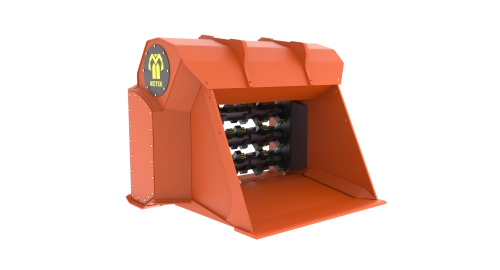
Screening buckets are particularly well-suited for projects requiring material separation and particle size control.
For instance, in earthworks, excavated soil may be mixed with stones, construction debris, or other impurities. A screening bucket can separate compliant fine material from larger particles; the screened material can then be used for backfilling, site grading, or other construction phases.
In agriculture and organic waste management, screening buckets are also used for processing compost and organic fertilizers, helping to boost efficiency by turning, screening, and improving material aeration.
If your primary needs involve screening, grading, separating, and material reuse, a screening bucket is generally the preferred option.
When is a crusher bucket more suitable?
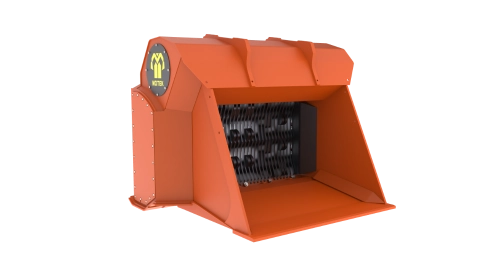
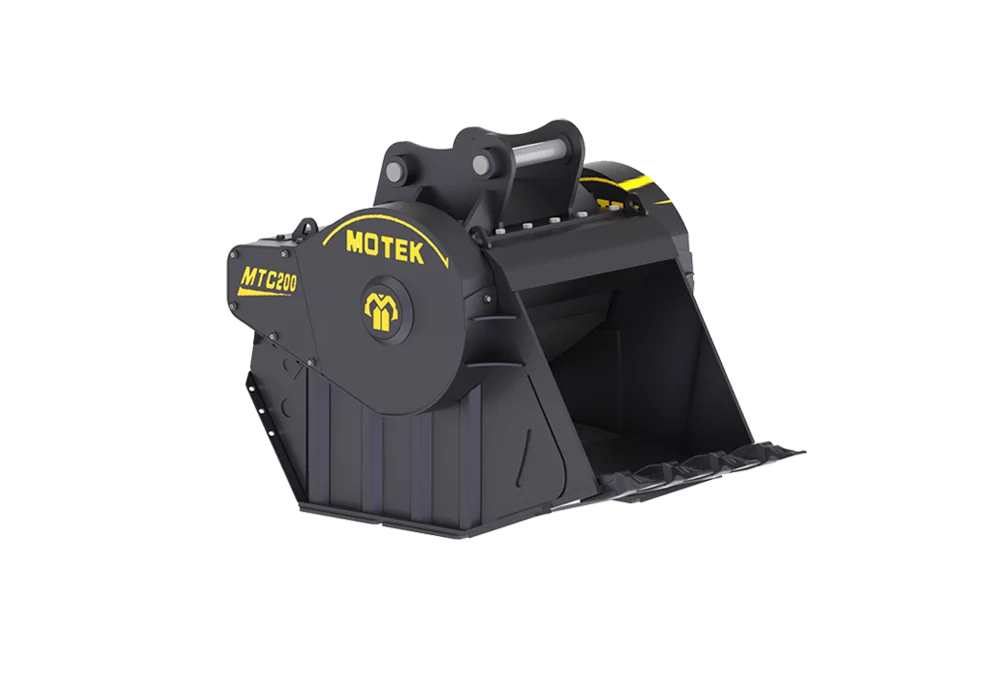
Crusher buckets are primarily used to process large, hard materials.
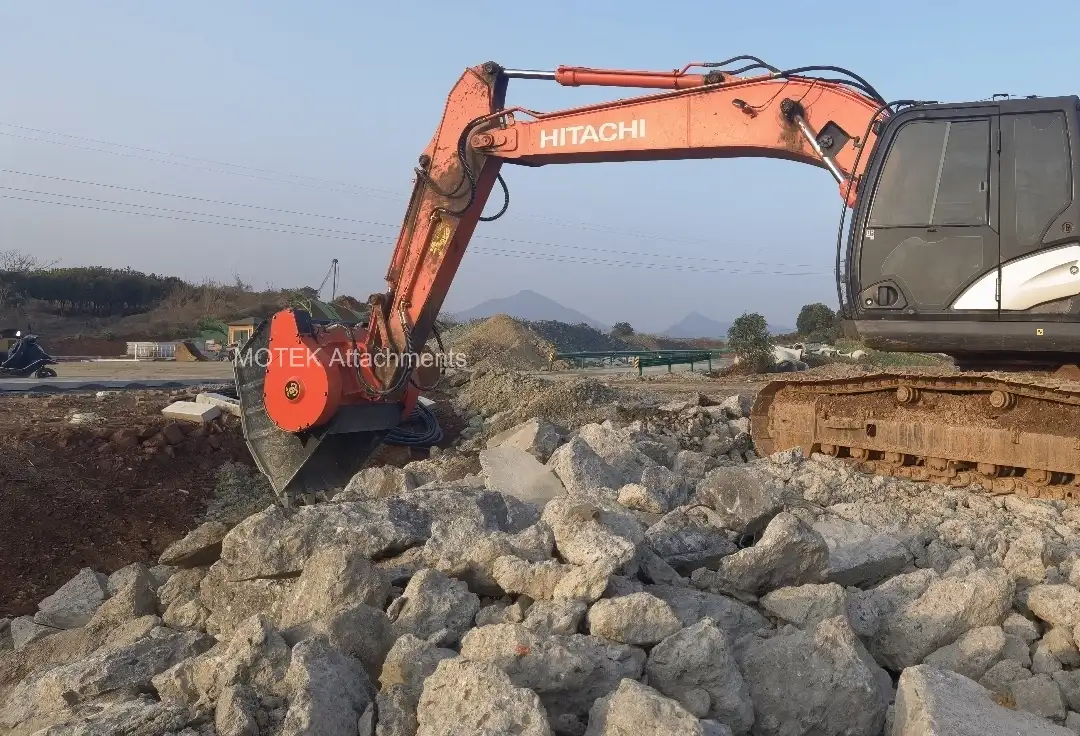
In building demolition projects, concrete blocks, bricks, and other construction waste often require crushing before they can be transported, recycled, or reused. Compared to transporting materials to a stationary crushing plant, an excavator-mounted crusher bucket allows for preliminary crushing to be performed directly at the construction site.
For instance, concrete blocks from road renovation projects can be reduced in size using a crusher bucket and then either used for backfill or as recycled aggregate, depending on project specifications.
Therefore, if the project focuses on the on-site crushing of concrete, rock, brick, or construction debris, a crusher bucket is often the more suitable choice.
Can a project utilize both a screening bucket and a crusher bucket?
Yes; in fact, for certain complex projects, these two attachments can create a continuous material processing workflow.
For example, in a building demolition project that generates large quantities of concrete and mixed construction waste, a crusher bucket can first reduce the size of large material chunks, followed by a screening bucket to sort and grade the crushed material.
Simply put, the process looks like this:
Excavation → Crushing → Screening → Separation → Reuse
This combination reduces the need for transporting and centrally processing materials while increasing flexibility for on-site material reuse.
Of course, the decision to deploy both types of equipment depends on factors such as project scale, material properties, excavator tonnage, and final product specifications.
Don’t just choose between a “screening bucket” and a “crusher bucket”
When making an actual purchase, several other key factors must be considered:
① Excavator Tonnage
Different attachment models have specific load and hydraulic system requirements; equipment compatibility must be verified.
② Material Type
Processing methods differ for soil, sand/gravel, and compost versus concrete and rock.
③ Target Particle Size
If there are specific requirements for the final particle size, pay close attention to screen mesh dimensions or the output size range of the crusher.
④ Processing Capacity
For large-scale construction projects, prioritize throughput (processing volume per unit of time) to prevent the equipment from becoming a bottleneck in the overall workflow.
⑤ Operating Environment
Applications such as mining, demolition, road construction, and agriculture place different demands on wear resistance, protective features, and ease of maintenance.
Why is choosing the right supplier for screening and crusher buckets equally important?
Selecting the right equipment is only the first step; a manufacturer’s product design, structural integrity, wear resistance, hydraulic system compatibility, and after-sales support will all significantly impact the attachment’s long-term performance. For overseas engineering contractors, equipment rental companies, and excavator operators, an ideal supplier offers more than just standard models; they provide tailored recommendations based on excavator tonnage, material type, processing capacity, and specific job-site conditions.
Why consider Motek?
If you are seeking a reliable screening bucket or crusher bucket for your project, Motek is a supplier worth exploring. Specializing in excavator attachments and material handling equipment, Motek offers solutions for screening, crushing, and more, tailored to diverse application scenarios.
For screening bucket requirements, focus on applications such as soil screening, material grading, backfilling, and organic material processing. For crusher bucket needs, consider options suited for building demolition, concrete processing, road construction, and on-site material reuse.
Rather than simply asking “which bucket is better,” the key is to determine which equipment best aligns with your specific materials and project goals. Prioritize a screening bucket if screening and grading are required; consider a crusher bucket if you need to reduce the particle size of large materials; and if the project involves both crushing and sorting, evaluate the combined use of both attachments.
Before finalizing your purchase, it is recommended that you provide Motek with details such as the excavator model/tonnage, material type, feed size, target output size, and expected processing volume. Their professionals can then assist you in selecting the most suitable screening or crusher bucket model.
Author

Gershon Zhou
MOTEK R&D Director With 18 years of focused experience in the construction machinery attachment industry. As a National Certified Senior Engineer, he is a well-recognized technical leader in the field of earthmoving machine attachments.