

How Excavator Screening and Crushing Buckets Support On-Site Material Recycling
Release time: 2026-08-23
Table of Contents
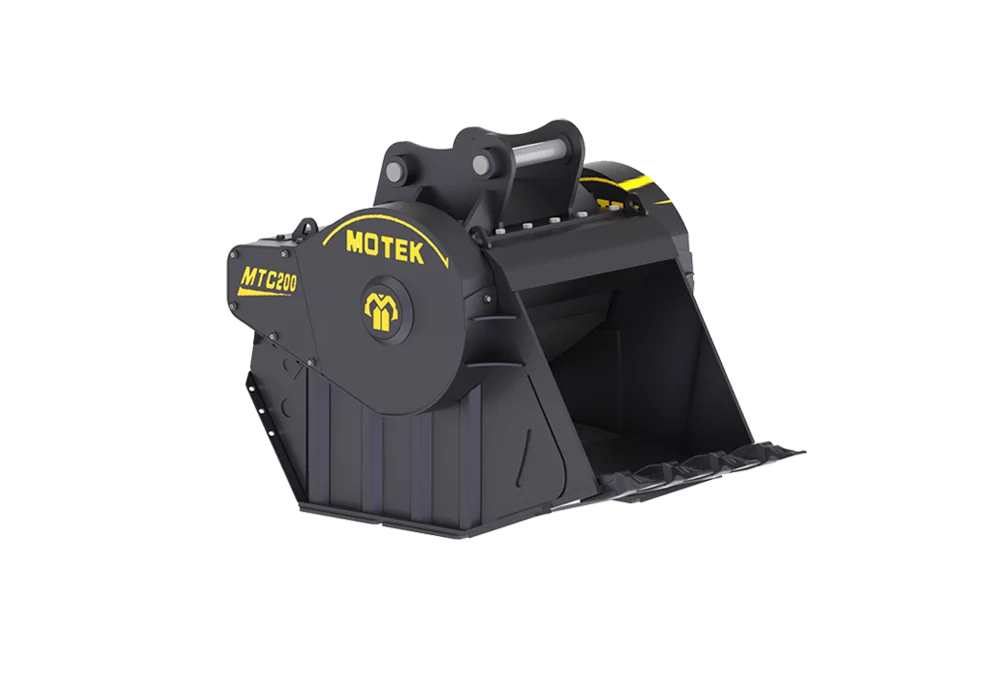
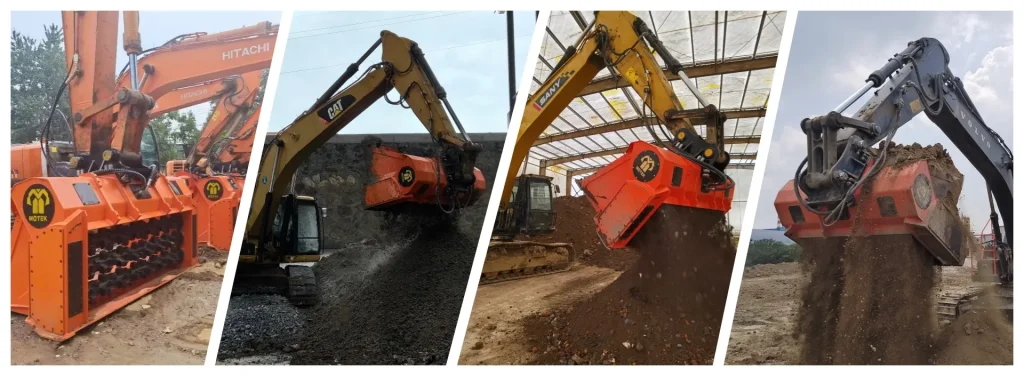
Construction and excavation projects often generate large amounts of soil, rocks, concrete fragments, sand, gravel, and mixed materials. Moving all of these materials away from the job site can increase transportation costs and make site logistics more complicated. MOTEK H Series offers an excavator-based approach that combines screening and crushing functions, allowing suitable materials to be processed closer to where they are generated.
For contractors working on road construction, demolition, excavation, landscaping, mining, or remote infrastructure projects, an excavator screening and crushing bucket can provide greater flexibility in handling materials. Instead of treating every excavated load as waste, suitable materials can be reduced, separated, and prepared for possible reuse according to project requirements.
The Challenge of Construction Material Handling
Material handling can become a significant part of project costs when excavated or demolished materials need to be transported several times.
A typical load may contain:
- Large rocks
- Fine soil
- Sand and gravel
- Concrete fragments
- Masonry and demolition waste
- Materials with different moisture levels
When these materials are transported without preliminary processing, contractors may need additional trucks, temporary storage areas, or external recycling facilities. At the same time, potentially reusable materials may be mixed with unsuitable waste.
This is why material processing at the job site is becoming an important consideration for projects where transportation distance, available space, and processing capacity affect overall efficiency.
Why On-Site Material Recycling Matters
On-site recycling involves processing suitable materials close to the location where they are excavated or generated. Depending on material quality and project requirements, this may involve screening, crushing, separation, and subsequent reuse.
A practical on-site processing system can potentially help with:
- Reducing unnecessary material transportation
- Lowering fuel consumption associated with hauling
- Making better use of excavated materials
- Reducing the amount of material sent to external facilities
- Simplifying material movement around the job site
- Providing more flexibility for remote construction work
The actual economic and environmental benefits depend on the material, project scale, local regulations, and processing requirements. However, the principle is straightforward: when suitable materials can be processed near their point of origin, the overall material flow may become easier to manage.
How Screening and Crushing Buckets Support Material Processing
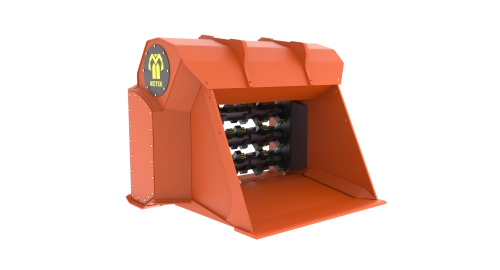
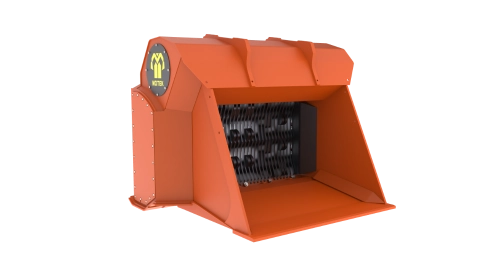
An excavator screening and crushing attachment combines two important material-processing functions in a single excavator-mounted unit.
Crushing helps reduce larger rocks, concrete pieces, and other hard materials into smaller sizes. Screening then separates the processed material according to particle size. This allows operators to obtain material fractions that may be more suitable for specific construction or site-development tasks.
The H Series is designed for coarse screening and crushing applications involving materials such as ore, construction waste, sand, gravel mixtures, and other materials. Its application can vary according to material characteristics, excavator specifications, and the selected equipment configuration.
For projects where bringing several stationary processing machines to the site is difficult, an excavator-mounted material screening and crushing bucket can offer a more flexible way to integrate processing into the existing excavation workflow.
How the On-Site Processing Workflow Works
A typical material-processing operation may follow several stages:
- The excavator collects soil, rocks, aggregates, or construction waste.
- Larger materials enter the screening and crushing bucket for size reduction.
- The processed material moves through the screening system.
- Materials are separated according to the required particle size.
- Suitable fractions are reused, stockpiled, or moved to another construction stage.
- Oversized or unsuitable material can be processed again or handled separately.
This workflow creates a closer connection between excavation, processing, and material reuse.
For example, rocks excavated during foundation work may be processed for potential use as filling material. Concrete fragments from demolition may also be reduced for possible recycled aggregate applications. Whether the processed material is suitable for a particular purpose depends on its quality, contamination level, engineering requirements, and applicable regulations.
What Materials Can Be Processed?
Different projects present different material conditions, so buyers need to consider more than simply the material name when evaluating equipment.
Rocks and Mineral Materials
Rocks and mineral materials may require size reduction before they can be screened or reused. On-site processing can be useful in quarrying, excavation, foundation work, and other projects where large quantities of rock are generated.
Material hardness and feed size are particularly important when determining whether a specific bucket configuration is appropriate.
Construction and Demolition Waste
Demolition work can generate concrete fragments, masonry, and mixed construction waste. Crushing and screening can help reduce material volume and separate different fractions for further handling.
For projects involving reinforced concrete or highly abrasive materials, the attachment configuration and wear-part requirements should be evaluated in advance.
Sand and Gravel Mixtures
Sand and gravel may need particle-size separation before being used for backfilling, roadwork, drainage, or other construction applications. Screening can help separate materials into more manageable fractions.
The required output size should be established before purchasing equipment because different projects may have different material specifications.
Soil and Excavated Materials
Excavated soil can contain rocks, gravel, and other unwanted particles. Screening can help prepare selected materials for landscaping, backfilling, and certain soil-related applications.
Moisture content is an important consideration, particularly when working with cohesive or wet materials.
Benefits for Contractors
Reduced Transportation Requirements
Processing suitable material at or near the job site may reduce the number of trips needed to external recycling or disposal facilities. This can be particularly valuable on projects located far from processing centers.
Fewer material movements can also make site logistics easier to coordinate.
Better Use of Available Materials
Excavated materials do not always need to be treated as waste. After screening and crushing, suitable material may be reused for filling, road construction, landscaping, or other applications.
This can reduce the amount of new material that needs to be purchased for certain project stages, although suitability must always be confirmed based on engineering requirements.
Fewer Separate Processing Stages
A combined screening and crushing attachment can handle basic size reduction and separation within one machine.
For smaller sites or projects with limited working space, this can be more convenient than moving materials between multiple processing machines.
Greater Flexibility on Remote Sites
Remote construction projects may not have easy access to fixed recycling plants or aggregate-processing facilities.
An excavator-mounted attachment allows material processing to become part of the existing excavation operation, giving contractors another option when conventional processing infrastructure is inconvenient or unavailable.
Applications Worth Considering
A screening and crushing bucket can be considered for a range of applications, including:
- Building demolition and construction waste processing
- Road construction and maintenance
- Foundation excavation
- Quarrying and mining
- Soil preparation and remediation
- Pipeline backfilling
- Landscaping and site development
- Remote infrastructure projects
The suitability of the equipment depends on the material being processed, required output, excavator specifications, and expected workload.
What Buyers Should Check Before Purchasing
Selecting an attachment based only on general crushing or screening capability can lead to compatibility and productivity problems. Buyers should evaluate the complete operating conditions before placing an order.
Key factors include:
- Excavator operating weight
- Hydraulic flow and working pressure
- Bucket weight and capacity
- Maximum feed size
- Desired output particle size
- Expected processing volume
- Material hardness
- Material moisture
- Wear-part availability
- Maintenance requirements
- Warranty and technical support
It is also important to distinguish between projects that primarily require coarse screening and those that require more intensive crushing. A configuration suitable for loose soil and gravel may not provide the same performance when processing hard rock or reinforced concrete.
Choosing the Right Supplier
The supplier’s technical capability is another factor worth considering, especially when the attachment will be used with different excavator models or under demanding working conditions.
MOTEK provides product development, manufacturing, technical support, and OEM/ODM services for attachment applications. Buyers with specific excavator models, material conditions, or project requirements can discuss equipment compatibility and configuration options with the supplier before making a purchasing decision.
For international buyers, obtaining detailed specifications in advance can also help clarify hydraulic requirements, expected processing capacity, application limitations, and replacement-part requirements.
FAQ
1. What materials can a screening and crushing bucket process?
Depending on the configuration and working conditions, it can be used for materials such as rocks, sand, gravel mixtures, construction waste, concrete fragments, and selected excavated materials.
2. Can one bucket perform both crushing and screening?
Yes. The H Series combines crushing and screening functions in one excavator attachment, helping reduce the need for separate processing stages.
3. What should I check before purchasing?
Excavator operating weight, hydraulic flow, working pressure, feed size, output size, material characteristics, and expected processing volume are among the key factors to confirm.
4. Is the H Series suitable for every construction project?
Not necessarily. Performance depends on material hardness, moisture, particle size, excavator compatibility, and the required output. Buyers should confirm the working conditions and configuration before purchase.
Conclusion
On-site material recycling can give construction and excavation companies another way to manage rocks, soil, aggregates, and construction waste. By processing suitable materials closer to where they are generated, projects may reduce unnecessary transportation, improve material utilization, and simplify site logistics.
The H Series brings screening and crushing into one excavator attachment, making it worth considering for projects that require flexible material processing without relying entirely on fixed facilities. MOTEK can provide the corresponding equipment and technical support for buyers evaluating different excavator and material conditions, giving contractors a practical starting point when planning on-site processing.