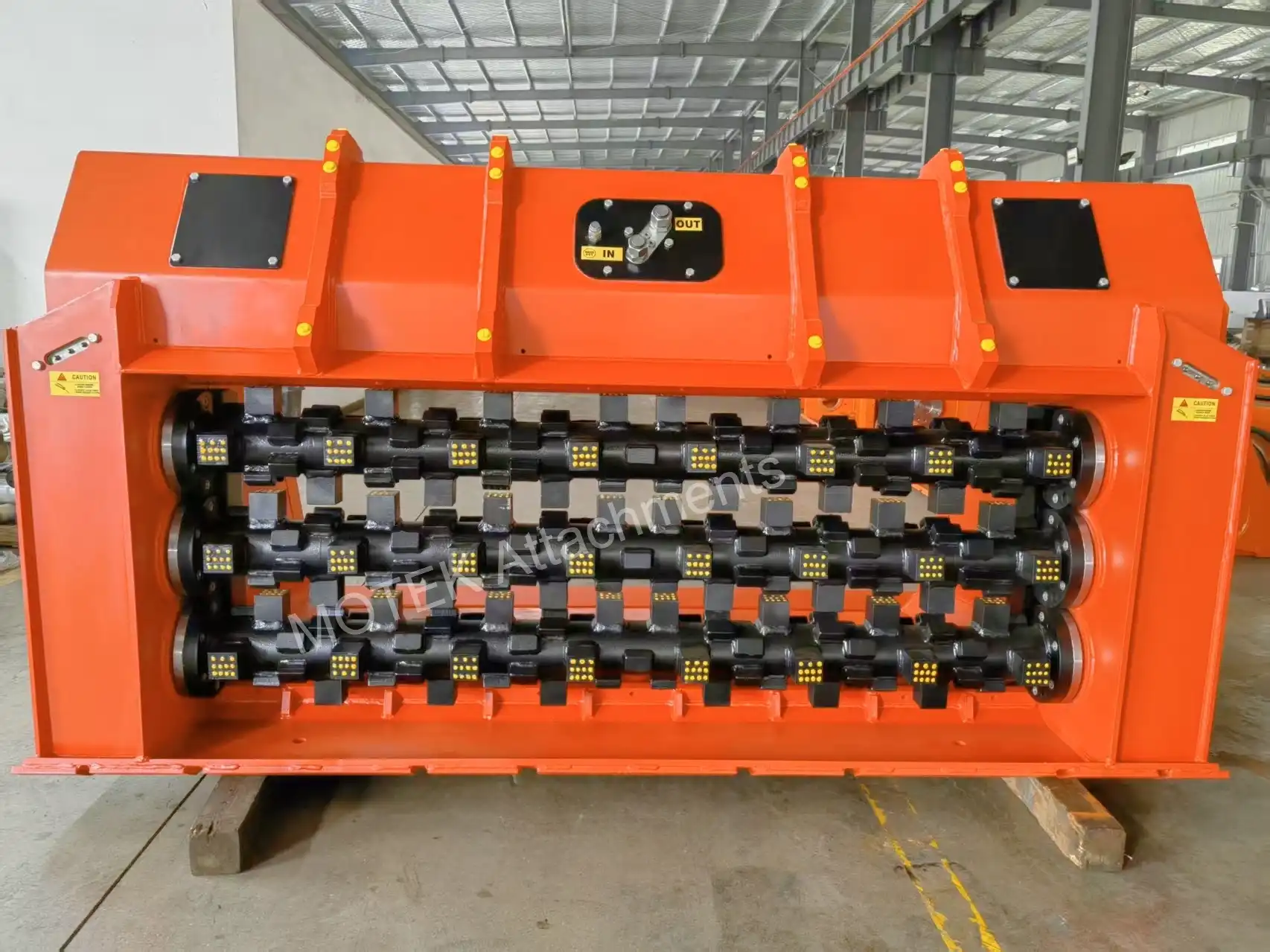


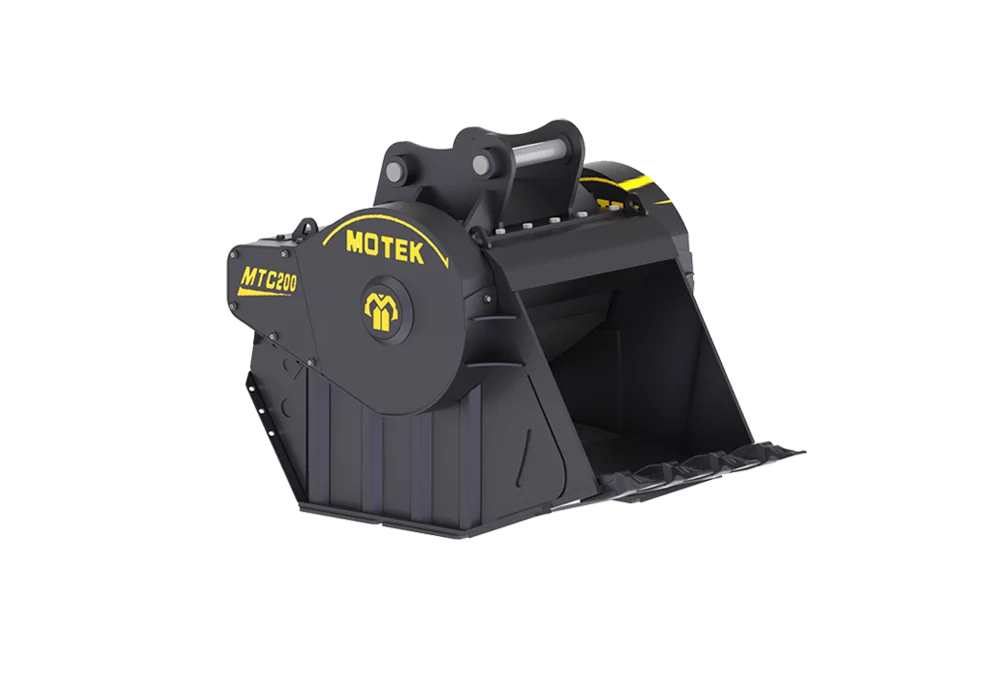
How do you select the right mobile crusher bucket for trench backfill aggregate?
Release time: 2026-06-30
In construction scenarios such as trench excavation, pipeline laying, and road repair, the particle size, gradation, and acquisition efficiency of backfill aggregate directly impact project quality and overall progress. Compared to purchasing aggregate externally, processing on-site materials via crushing effectively reduces transportation costs and improves material utilization. With features like flexible mobility, on-site crushing, and efficient volume reduction, mobile crusher buckets have become practical tools for producing trench backfill aggregate. Selecting the appropriate model helps contractors maintain high efficiency even in confined spaces and complex working conditions.
Why is the right crusher bucket particularly important for trench backfilling?
Trench backfilling imposes specific requirements regarding aggregate particle size, uniformity, and cleanliness. Oversized aggregate can create voids after backfilling, compromising compaction quality, while poor gradation reduces load-bearing capacity. Mobile crusher buckets serve to rapidly process large on-site materials into suitable backfill aggregate, ensuring the material meets construction specifications. This approach is especially practical for projects with limited space, tight schedules, or the need for frequent relocation.
What factors should be considered when selecting a mobile crusher bucket?
When choosing equipment, one should look beyond price and focus on suitability for specific working conditions. Material characteristics, production requirements, and construction environments vary significantly between projects; therefore, selection should be based on the following aspects:
- Processing capacity: Ability to meet the aggregate demand for trench backfilling.
- Output particle size: Ability to consistently maintain a size range suitable for backfilling and compaction.
- Excavator compatibility: Compatibility with the tonnage and hydraulic system of existing equipment.
- On-site mobility: Ease of use in narrow trenches and across multiple work sites.
- Wear resistance: Suitability for long-term processing of hard materials like stone and concrete.
- Ease of maintenance: Accessibility for replacing wear parts and impact on the construction schedule.
How do you make a decision based on different working conditions?
The table below helps quickly match common requirements with key equipment considerations:
| Construction Requirements | Key Focus Areas | Selection Recommendations |
| Trench backfill particle size control | Discharge uniformity | Selection of equipment with stable and adjustable particle size output |
| Constrained on-site space | need for maneuverability and flexibility | select compact equipment that is easy to relocate |
| Processing hard concrete blocks | Crushing capacity | Select models featuring wear-resistant, robust construction and an optimized crushing chamber design. |
| Tight schedule | continuous operation capability | select a crushing bucket that offers high efficiency and easy maintenance. |
| Multi-point operation | Adaptability | Select attachments that offer quick installation and high compatibility. |
How do crusher buckets improve backfilling efficiency?
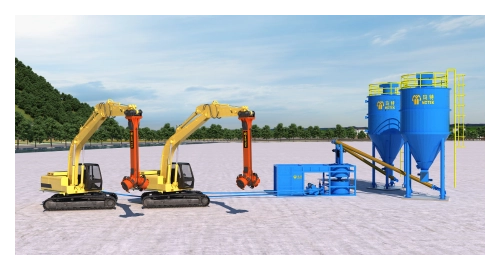
The primary advantage of a mobile crusher bucket is its ability to integrate excavation, crushing, and backfill preparation into a single on-site workflow. This eliminates the need for contractors to transport large materials to a fixed processing site or rent additional machinery. For trench backfilling, this translates to reduced downtime, lower logistics costs, and higher material utilization rates.
Furthermore, on-site crushing ensures a more stable supply of backfill aggregate, minimizing construction disruptions caused by inconsistent specifications in externally sourced materials. Such stability is crucial for projects involving municipal utility networks, road repairs, and underground infrastructure.
Key Equipment Features for Such Projects
When selecting equipment primarily for trench backfilling, the following features should be prioritized:
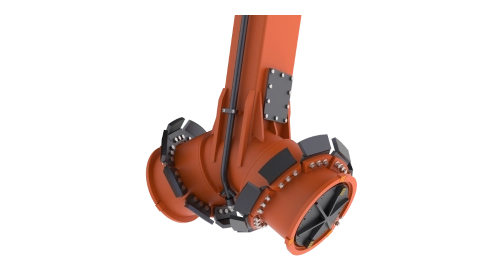
- A robust bucket structure capable of repeatedly processing hard materials.
- Consistent crushing performance with controllable output particle size.
- A responsive hydraulic system that facilitates efficient coordination with the excavator.
- Ease of maintenance to minimize downtime.
- Suitability for confined spaces, allowing for flexible operation around the trench.
It is not necessarily a case of “the more features, the better”; rather, a balance must be struck based on the specific project. For instance, small-scale municipal maintenance prioritizes flexibility, whereas large-scale utility network projects place greater emphasis on production capacity and durability.
Selecting the right aggregate for trench backfilling hinges on matching material hardness, output particle size, processing capacity, and on-site conditions. For projects requiring frequent relocation, operating in confined spaces, or aiming for high-efficiency backfilling, mobile crusher buckets significantly boost on-site processing capabilities. Motek mobile crusher buckets, in particular, emphasize structural durability, operational stability, and adaptability to site conditions. They are ideal for on-site crushing in trench backfilling, road repair, and construction waste management, offering contractors a more efficient and cost-effective solution.