

MOTEK Crusher Bucket: Turning Construction Waste into a Valuable Resource Right on Site
Release time: 2026-06-30
At construction sites involving infrastructure renovation, urban renewal, road repairs, and building demolition, construction waste has emerged as a major challenge for contractors. Historically, solid construction waste—such as concrete blocks, crushed stone, brick and tile debris, and asphalt fragments—has largely been managed through off-site transport for landfilling or centralized stockpiling. These methods not only incur high costs for transportation, site usage, and landfill fees while consuming significant manpower and resources, but also readily lead to issues like dust pollution, land occupation, and resource waste. Furthermore, increasingly stringent environmental regulations have driven up the compliance costs associated with these traditional waste management models. Meanwhile, while many large-scale projects invest heavily in fixed crushing and screening stations to facilitate waste recycling, the exorbitant costs—covering equipment procurement, site infrastructure, installation, commissioning, and ongoing maintenance—place an unbearable burden on small and medium-sized enterprises. These companies are often trapped in a dilemma: losing money by processing the waste versus wasting resources by leaving it idle.
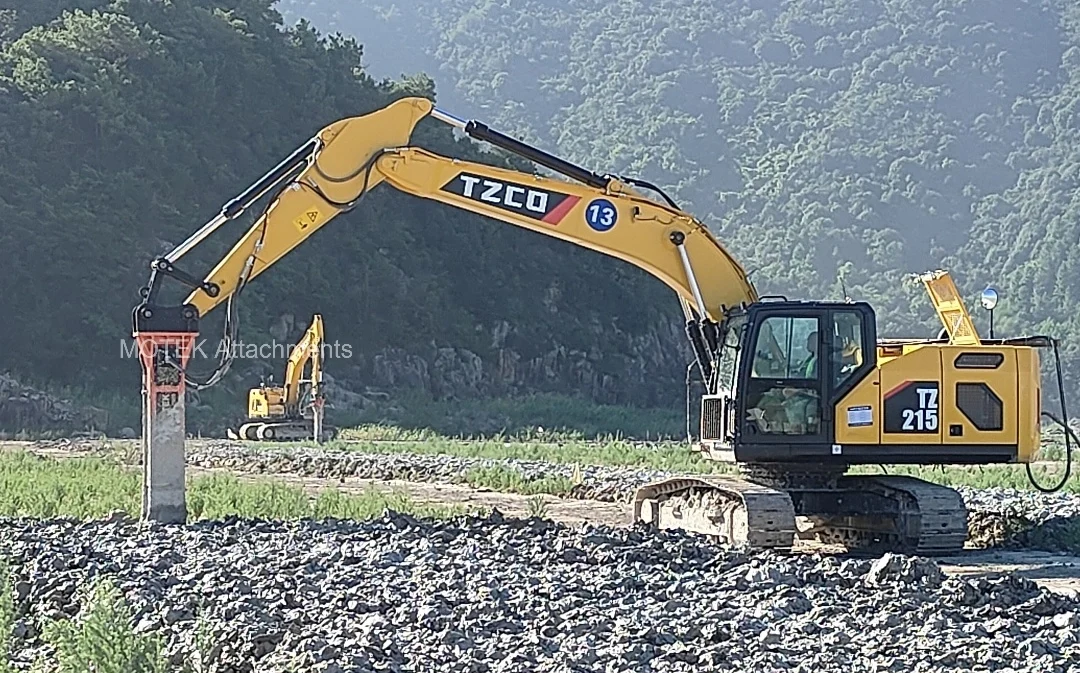
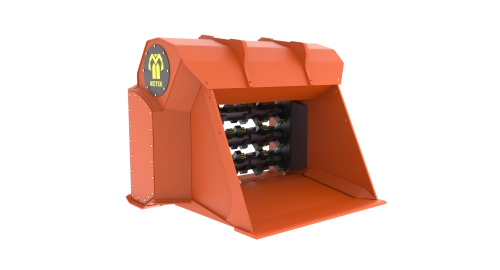
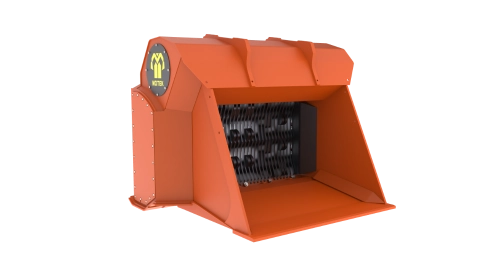
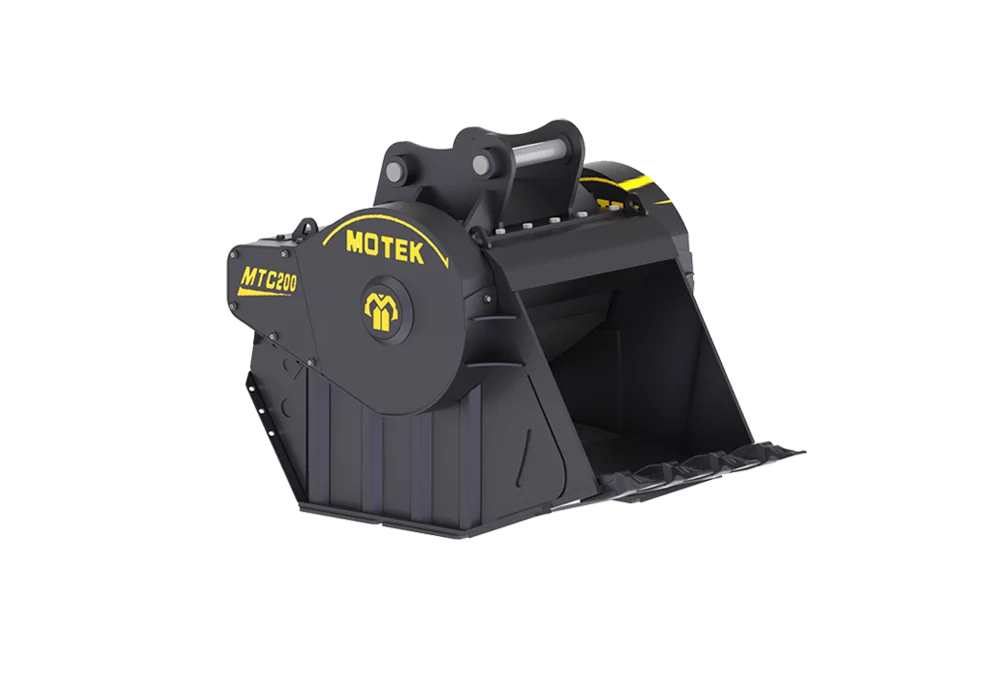
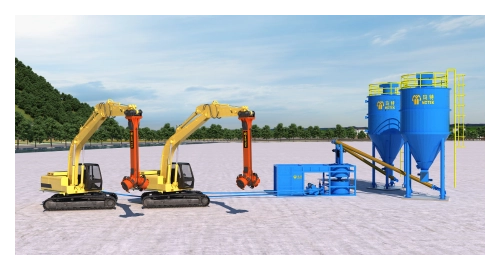
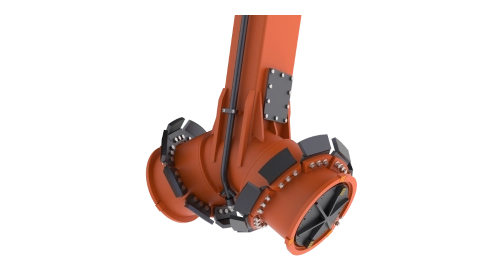
With years of deep expertise in the engineering equipment sector and a keen understanding of industry pain points and market demands, MOTEK proudly launches the **MOTEK Crusher Bucket**. This product revolutionizes traditional construction waste management by enabling on-site crushing, screening, and recycling—delivering immediate revenue generation. Eliminating the need for fixed crushing stations or massive capital investment, it mounts directly onto excavators for rapid operation, transforming various types of construction waste into standardized recycled aggregates on-site. These materials can be reused for backfilling or sold directly, helping construction firms drastically cut operating costs and unlock new revenue streams—making it an essential tool for green infrastructure and high-efficiency construction in the modern era.
Traditional stationary crushing stations are the mainstream equipment for large-scale aggregate processing and centralized waste treatment; however, for the vast majority of decentralized, small-to-medium-sized, and temporary construction projects, they present numerous unavoidable drawbacks and are a major factor behind the high costs faced by engineering firms. First, the initial investment is extremely high; a complete stationary crushing and screening line—comprising crushers, screens, conveyors, hoppers, electrical control systems, and other components—can easily cost hundreds of thousands or even over a million, not to mention the substantial expenses for site leveling and paving, safety installations, and utility infrastructure. Second, they suffer from poor flexibility and low resource utilization; once erected, a stationary station cannot be relocated and serves only a single, fixed site. They are entirely unsuitable for scattered projects such as urban demolition, multi-location municipal works, or township redevelopment, leading to idle equipment and wasted land after project completion, as well as immense financial strain due to tied-up capital.
Furthermore, stationary crushing plants entail high operating and maintenance costs and complex operational workflows; they require specialized personnel and regular servicing, consume significant amounts of electricity, and involve a lengthy setup process—including equipment delivery, installation, commissioning, and dismantling—that can take weeks or even months, severely delaying construction schedules. Regarding waste disposal, the traditional model requires contractors to consolidate construction debris and transport it over long distances to a fixed crushing site. The cumulative costs
—including fuel for round-trip transport, vehicle wear and tear, and labor, alongside landfill compliance fees and environmental remediation expenses—drive the disposal cost per ton of debris to consistently high levels. In terms of aggregate usage, the traditional approach necessitates purchasing finished aggregates for backfilling, roadbed construction, and site paving; this cycle of purchasing and transporting creates a double cost burden that drastically squeezes project profit margins.
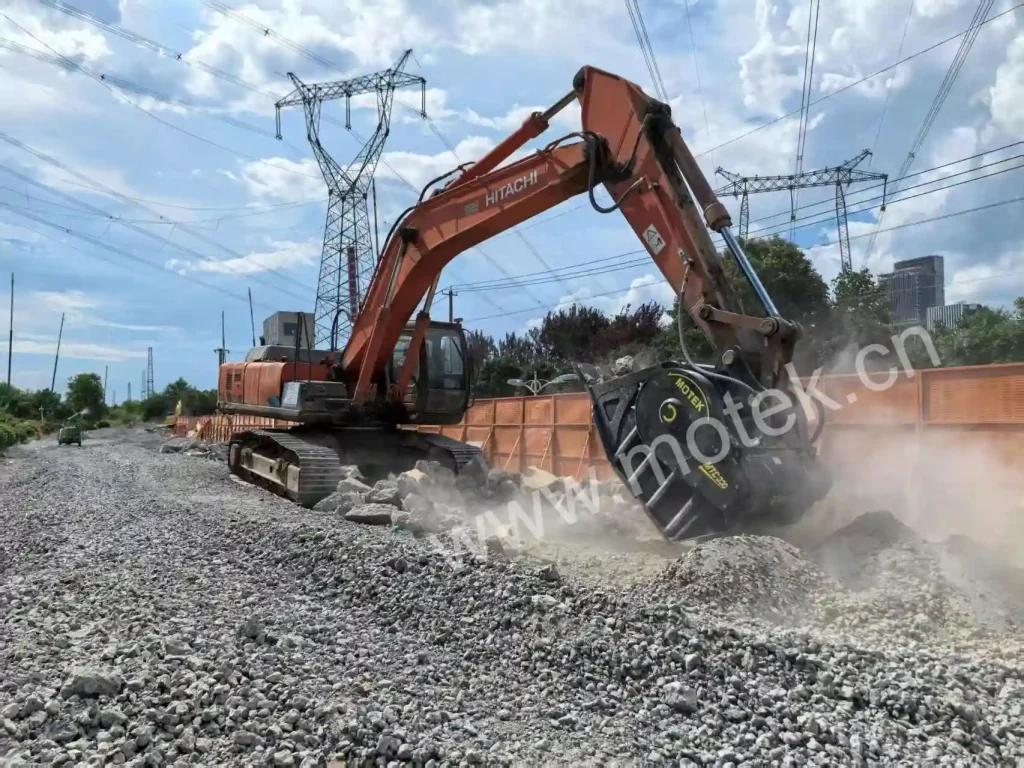
The launch of the MOTEK rock crusher bucket perfectly resolves the pain points associated with stationary crushing plants. Through an innovative design that is lightweight, modular, and mobile, it enables a new model for recycling construction waste—one that eliminates the need for massive infrastructure investment, site constraints, and complex maintenance. As a hydraulic attachment compatible with mainstream excavators, the MOTEK crusher bucket requires no dedicated production lines, site modifications, or external power sources; it can be quickly put into operation simply by attaching it to an excavator. Installation is convenient and operation is intuitive—requiring only brief training for standard operators to achieve proficiency—thereby completely eliminating the high costs of procurement, infrastructure, installation, and maintenance associated with stationary plants. This saves enterprises hundreds of thousands or even over a million in upfront investment and fundamentally lowers the barrier to entry for construction projects.
In terms of operational performance,MOTEK concretes crusher bucket combines efficient crushing with precise screening, truly enabling integrated on-site processing. Powered by the excavator’s hydraulic system, the unit delivers robust power and strong crushing force, capable of efficiently processing various types of construction waste—such as concrete blocks, bluestone, granite, brick and tile debris, and asphalt waste
—into uniformly sized, controllable output. Its integrated screening structure allows for the precise sorting of recycled aggregates into specifications that meet national standards, making it ideal for internal project applications such as roadbed backfilling, site leveling, sub-base laying, and access road hardening. Unlike traditional equipment that often yields inconsistent quality, mixed impurities, and uneven particle sizes, the MOTEK crusher bucket produces high-quality, premium-grade recycled aggregates that fully meet market sales standards, offering exceptional reuse potential and commercial value.
With its agile mobility and universal adaptability, the MOTEK crusher bucket meets the demands of a wide range of construction scenarios. Whether for the demolition of aging urban residential complexes, urban village redevelopment, municipal road upgrades (converting concrete to asphalt), or utility network modernization—as well as rural home demolition, small-scale quarrying, or on-site debris processing
—the equipment allows for rapid deployment and immediate operation. It moves freely alongside the excavator, unconstrained by site size, terrain, or specific location, truly realizing an efficient workflow where crushing happens on arrival, processed material is ready for immediate use, and material stockpiles serve as production lines. This solution fundamentally resolves industry challenges associated with stationary crushing plants—such as difficult relocation, poor adaptability, and high idle rates
—while significantly enhancing operational flexibility and efficiency to effectively shorten project timelines.
Reducing costs and increasing efficiency is merely the baseline; the true core competitiveness of the MOTEK crusher bucket lies in monetizing waste and generating additional revenue, thereby opening up a brand-new profit stream for construction enterprises. Under traditional construction models, construction waste represents a pure “cost burden”—disposal incurs fees, stockpiling violates regulations, off-site transport is expensive, and leaving it idle is wasteful, yielding absolutely no return. However, by utilizing the MOTEK crusher bucket, construction waste is transformed from mere refuse into recyclable, “high-quality resources.” Various types of solid waste generated on-site are crushed and screened locally to produce premium recycled aggregates; these can fully replace purchased stone for the project itself, directly saving on procurement costs and significantly reducing overall material expenses.
Moreover, the resulting recycled aggregate can be sold directly to a wide range of sectors—including building material processing plants, roadbed construction, municipal projects, and landscaping infrastructure—ensuring stable demand and broad market reach. Amidst tight supplies of natural sand and gravel and rising prices for finished aggregates, high-quality recycled aggregate is highly favored by the market for its cost-effectiveness. By utilizing MOTEK crusher buckets, construction companies can continuously produce marketable recycled aggregate from on-site waste materials without the need for additional equipment investment or extra site space. This transforms what would have been a waste disposal cost into tangible revenue—effectively turning waste into a valuable asset and a source of income—thereby significantly boosting the project’s overall profit margin and delivering a triple benefit: reduced costs, increased efficiency, and higher earnings. Industry data indicates that on-site waste processing using crusher buckets can cut overall solid waste disposal costs by more than 40%; when combined with revenue from aggregate sales, the overall boost to profitability is substantial.
In terms of environmental compliance, MOTEK crusher buckets align perfectly with national policy directives promoting green construction and the resource utilization of solid waste. With domestic environmental regulations becoming increasingly stringent—and practices such as indiscriminate dumping, off-site landfilling, and improper disposal of construction waste facing severe penalties—traditional, crude waste management methods are no longer viable. MOTEK crusher buckets enable 100% on-site resource recovery of construction waste, reducing the volume of waste requiring off-site transport and landfilling at the source. By effectively mitigating environmental pollution caused by construction dust and debris transport, these buckets help sites meet green construction standards and pass environmental inspections with ease. This allows enterprises to avoid the risks of mandatory environmental rectifications and compliance fines, ensuring lawful, compliant, and steady progress in their construction operations.
Compared to standard crushing equipment on the market, the MOTEK crusher bucket offers comprehensive upgrades in quality, performance, and durability, striking an ideal balance between cost-effectiveness and practicality. Constructed from high-strength, wear-resistant materials, the unit features thickened and reinforced core crushing components that are highly resistant to impact and wear; built to withstand rigorous, continuous, and heavy-load operations, it boasts a low failure rate and an extended service life. Its compact structure and mature engineering design ensure excellent sealing, resulting in minimal dust and noise during operation—fully compliant with urban construction environmental standards. Furthermore, the equipment is easy to maintain and experiences minimal wear; it requires no specialized maintenance personnel, needing only routine cleaning and care for long-term, stable operation. When contrasted with the high operating and maintenance costs of stationary crushing plants, its ongoing usage costs are virtually negligible, truly delivering “one-time investment with long-term benefits.”
For small and medium-sized construction teams, engineering firms, municipal contractors, and demolition companies, the MOTEK crusher bucket represents the most cost-effective solution with the best return on investment for construction waste processing. It eliminates the need for massive capital investment in fixed production lines or the risk of idle equipment; instead, it leverages existing excavators to upgrade resource-recovery capabilities. This solution not only resolves on-site waste disposal challenges, cuts costs, and accelerates project timelines but also generates additional revenue through the sale of recycled aggregates, thereby boosting the enterprise’s core competitiveness. In an industry characterized by fierce competition and shrinking profit margins, the MOTEK crusher bucket—with its advantages of low cost, high flexibility, strong revenue generation, and robust regulatory compliance—has become an essential tool for engineering firms seeking to break through market saturation, enhance quality and efficiency, and drive profitability.
Green infrastructure is the industry trend, and resource recycling represents a lucrative opportunity. Move away from traditional construction waste management methods—characterized by high costs, low efficiency, and excessive waste—and choose the MOTEK crusher bucket. Eliminate the heavy financial burden of investing in stationary crushing plants and unlock a revolutionary operational model featuring on-site crushing, screening, reuse, and monetization. Transform construction waste into valuable resources, drastically cut construction costs, and steadily boost project profits. Empowering industry professionals to excel in the green infrastructure sector, capture market opportunities, and achieve efficient operations, regulatory compliance, and sustained profitability.
Author

Lilly Liu
MOTEK Director of International Sales Equipped with 15 years of dedicated experience in the construction machinery industry, she has a deep understanding of global market dynamics and regional customer needs. She has successfully led teams to penetrate key international markets, particularly in promoting construction machinery attachments and securing high-value overseas orders.