


Which type of crusher bucket attachment is suitable for handling demolition waste?
Release time: 2026-07-02
Table of Contents
In the modern demolition and construction sector, waste management is no longer just a logistical hurdle—it is a critical profit center. When tearing down a structure, contractors are left with mountains of concrete, brick, asphalt, and rebar. Paying to haul this material to a landfill, paying tipping fees, and then paying to truck in new aggregate for the next phase of construction is an outdated and expensive cycle.
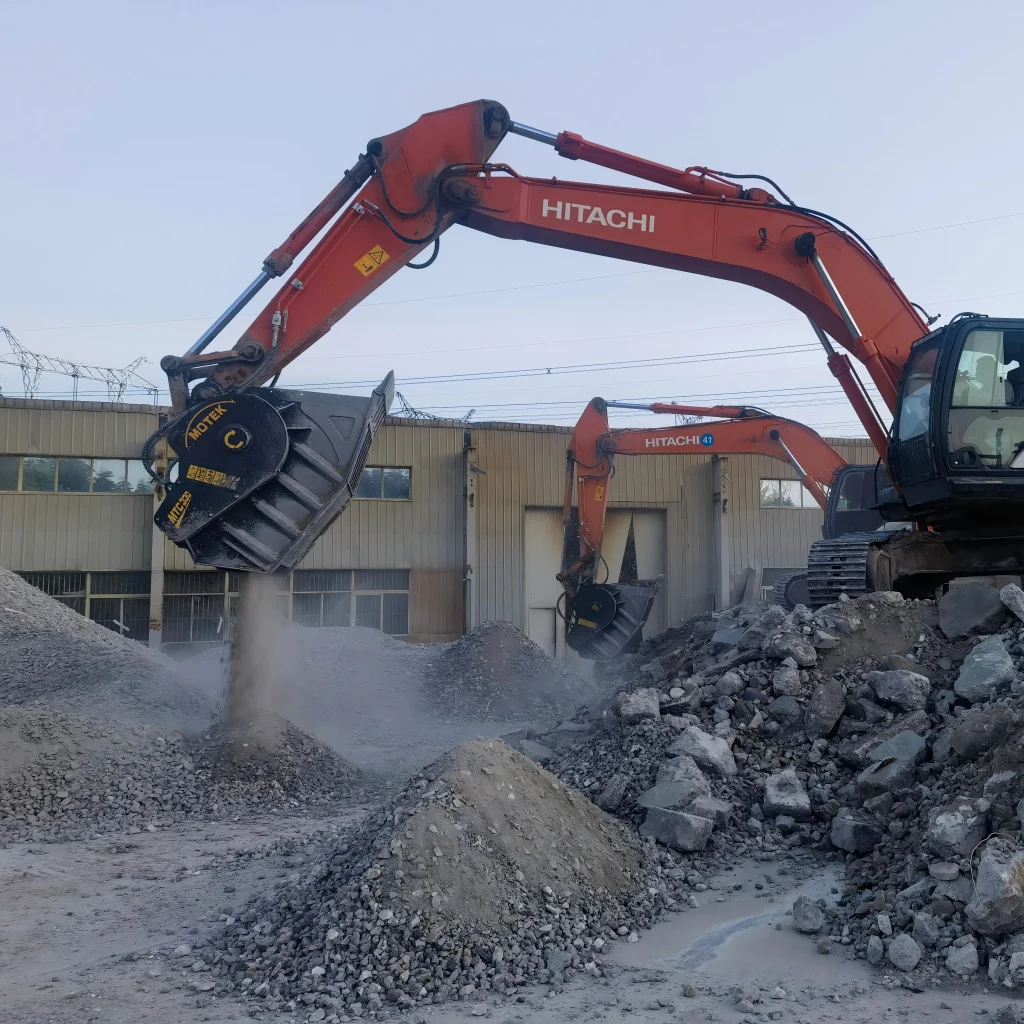
The solution is on-site recycling. By equipping an excavator with a crusher bucket attachment, contractors can transform raw demolition debris into valuable, reusable aggregate right on the job site. But demolition waste is notoriously unforgiving. It is abrasive, heavy, and often laced with hidden steel rebar.
So, which type of crusher bucket attachment is actually suitable for handling demolition waste? To maximize the utility of your fleet—whether you are running brand-new models or reliable, high-quality used construction machinery—selecting the right crushing mechanism is paramount. Here is a comprehensive breakdown of the technology and how to choose the right tool for your next tear-down.
The Core Challenge of Demolition Debris
Unlike natural river rock or soft limestone, demolition waste presents unique mechanical challenges:
- High Compressive Strength: Cured structural concrete is incredibly hard and abrasive.
- Steel Contamination: Reinforced concrete contains rebar, wire mesh, and steel plates. If a crusher cannot handle or bypass metal, it will jam or suffer catastrophic mechanical failure.
- Mixed Materials: A single scoop might contain brick, wood fragments, asphalt, and concrete chunks.
To process this safely and efficiently, you need an attachment designed for high-stress, abrasive environments.
The Jaw Crusher Bucket: The Undisputed King of Demolition
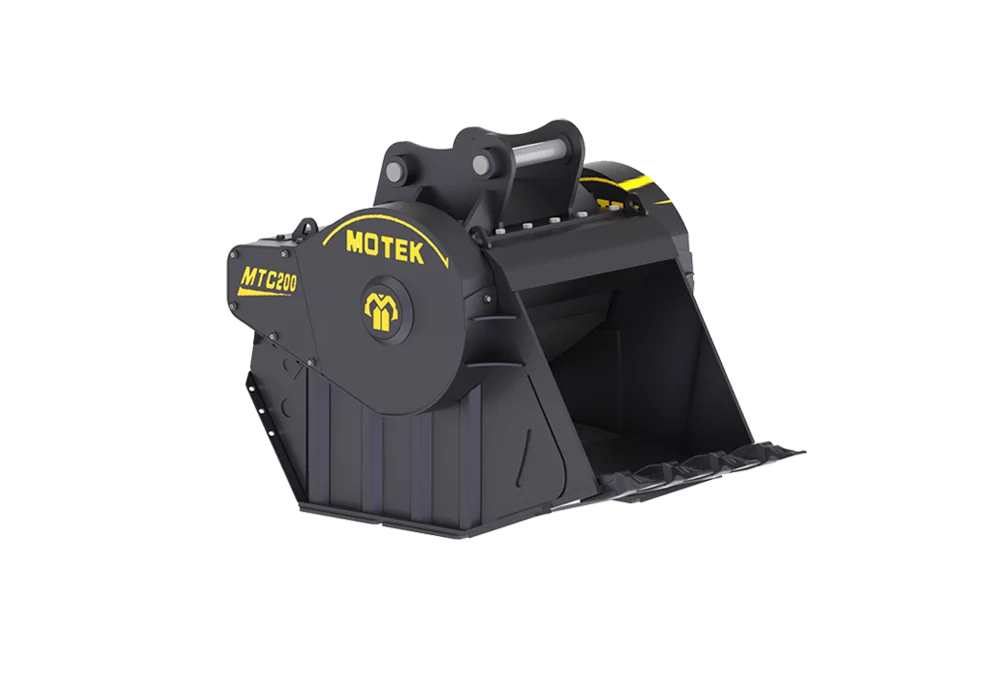
When it comes to primary demolition waste, the jaw crusher bucket is universally recognized as the best and most reliable solution.
Operating on a relatively simple but brutally effective principle, jaw crushers feature one fixed internal plate and one moving plate (the jaw) that moves in an eccentric, crushing motion. As the excavator bucket scoops the concrete, gravity feeds the material downward into the V-shaped crushing chamber. The moving plate crushes the concrete against the fixed plate until the pieces are small enough to fall through the adjustable gap at the bottom.
Why Jaw Crushers Excel in Demolition
- Handling Rebar and Steel: This is the primary reason jaw crushers dominate demolition. When concrete is crushed in a jaw bucket, the brittle concrete shatters and falls through, while the flexible steel rebar passes through the jaws. Many high-end jaw crusher buckets can also be fitted with an overband iron separator (an electromagnet) that pulls the freed rebar out of the crushed aggregate as it exits the bucket.
- Unmatched Durability: Jaw crushers operate at lower speeds with extremely high torque. The wear parts (the jaw plates) are typically made from heavily reinforced, abrasive-resistant steel, allowing them to withstand the constant grinding of hard concrete and brick without needing constant replacement.
- Low Maintenance: Because they have fewer rapidly spinning moving parts compared to other crusher types, jaw buckets are easier to maintain on a dusty, rugged job site.
Rotor / Impact Crusher Buckets: Speed Over Strength
While jaw crushers are the go-to for concrete and rebar, the rotor or impact crusher bucket has a specific place in the recycling ecosystem.
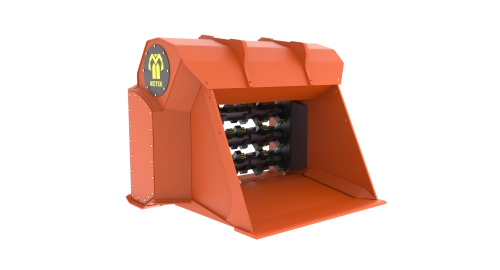
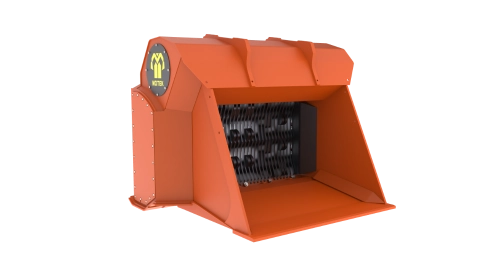
Instead of squeezing the material, an impact crusher uses a rapidly spinning rotor fitted with heavy hammers or blow bars. When the material enters the chamber, it is struck violently by the spinning rotor and smashed against impact plates until it shatters.
When to Use Impact Crushers
Impact crusher buckets are incredibly fast and produce a beautifully uniform, cubical aggregate. However, they are generally not recommended for primary demolition waste containing heavy rebar. If a piece of thick steel rebar gets tangled in a rapidly spinning rotor, it can cause severe damage to the attachment and the excavator’s hydraulic system.
Where impact buckets do excel is in processing:
- Asphalt and Tarmac: Impact crushers easily shred softer, sticky materials like asphalt without gumming up the internal chamber.
- Clean Brick and Cinderblock: For structures without steel reinforcement, impact crushers can process brick and block at a much faster volume than a jaw crusher.
Key Factors When Selecting Your Attachment
Choosing between a jaw or impact mechanism is only step one. To ensure a profitable and efficient demolition operation, you must match the bucket to your specific equipment and output needs.
1. Excavator Compatibility and Carrier Weight
A crusher bucket is a heavy attachment. When full of concrete, the weight is immense. You must ensure that your excavator has the appropriate operating weight and lifting capacity to handle the bucket safely without tipping. Furthermore, the excavator’s hydraulic flow (liters per minute) and pressure (bar) must perfectly match the requirements of the attachment.
For contractors sourcing equipment, acquiring a heavy-duty used excavator in the 20-to-30-ton class often provides the perfect, cost-effective base machine for running high-capacity jaw crusher buckets.
2. Output Size Adjustability
Different projects require different backfill sizes. If you are crushing concrete to use as a road base, you may need a 50mm output. If you are creating coarse fill for a trench, a 100mm output might suffice. Ensure the crusher bucket you choose allows operators to quickly and easily adjust the gap setting on the job site without requiring specialized tools or hours of downtime.
3. Loading Capacity and Mouth Size
The wider the mouth of the bucket, the larger the pieces of concrete you can scoop without needing to pre-break them with a hydraulic hammer. A larger capacity speeds up the workflow, reducing the amount of time your operator spends breaking down oversized slabs.
Conclusion: Maximizing Demolition ROI
To answer the core question: for handling standard demolition waste containing concrete, brick, and rebar, a jaw crusher bucket is the most suitable, durable, and reliable choice. It is purpose-built to separate steel from stone while withstanding the harshest abrasive conditions.
Investing in on-site recycling technology transforms waste from a liability into a highly profitable asset. By eliminating haul-away fees, cutting landfill tipping costs, and producing your own reusable aggregate, a crusher bucket pays for itself rapidly. When paired with a reliable, well-maintained excavator, it elevates your company’s operational capabilities, making you more competitive, more sustainable, and more profitable on every demolition bid.
Contact our team to find the ideal carrier excavator or to learn more about outfitting your current fleet with the right demolition attachments.

