

What type of crusher bucket attachment is suitable for a compact mobile crushing station?
Release time: 2026-06-15
Table of Contents
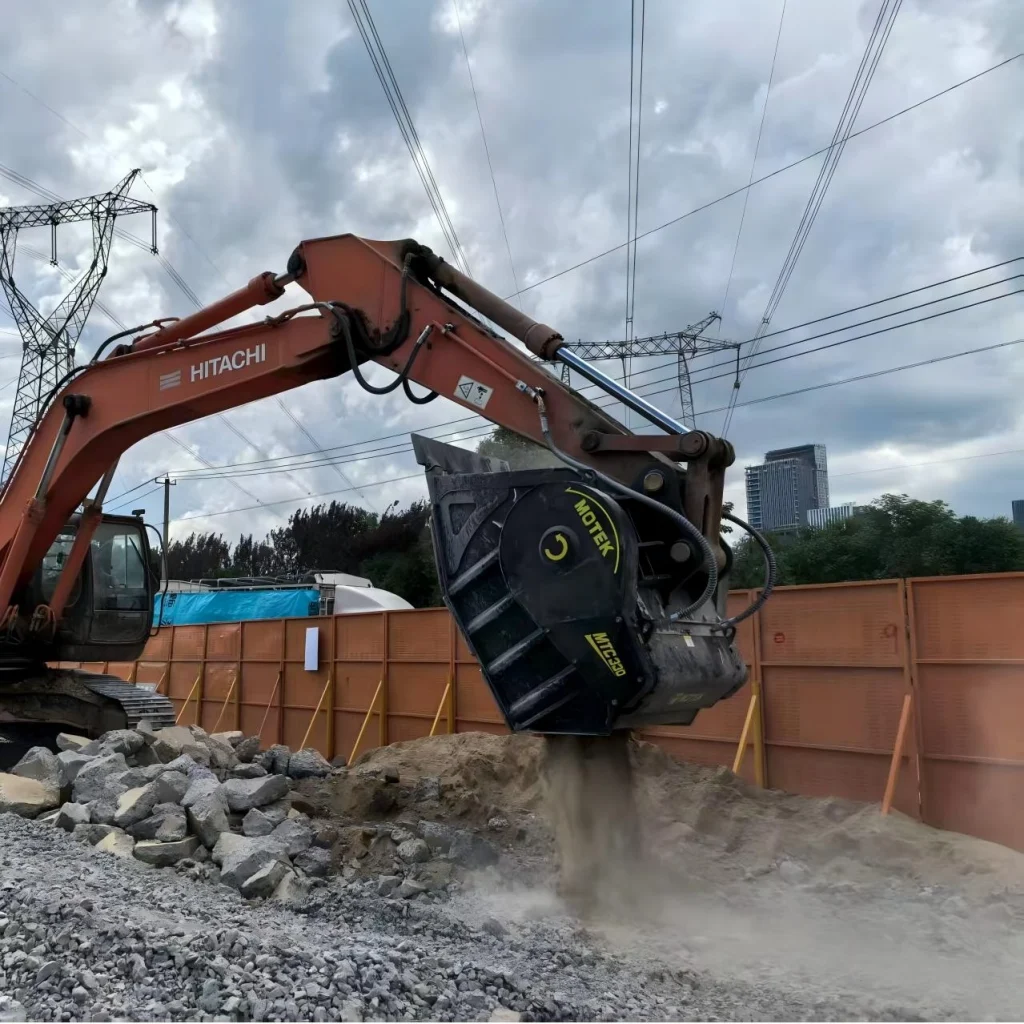
As urban demolition sites become tighter and the cost of hauling construction waste skyrockets, the B2B machinery market is witnessing a massive shift toward on-site recycling. For contractors operating in confined spaces, traditional track-mounted crushers are simply too large. The solution is the compact mobile crushing station—a nimble carrier machine paired with a specialized crusher bucket attachment.
But compact machines present a unique engineering challenge: they lack the massive hydraulic flow and heavy counterweights of 30-ton excavators. Therefore, selecting the correct type of crusher bucket is not just about aggregate size; it is about protecting the carrier while maximizing ROI.
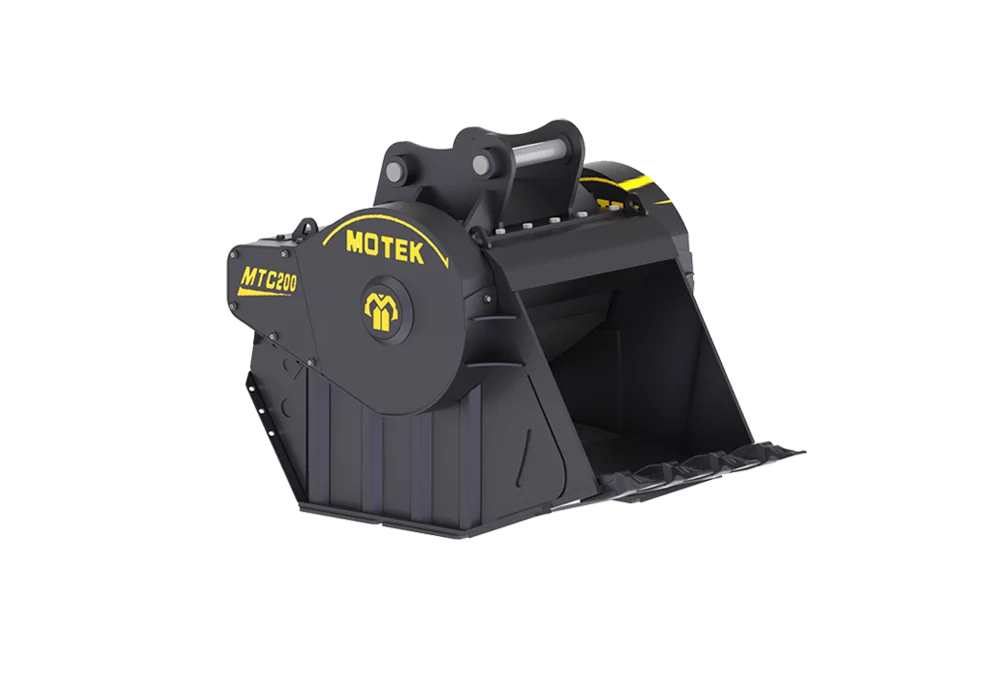
As the leader in China’s crusher bucket industry, MOTEK has engineered the definitive framework for equipping compact machines. Here is the technical breakdown of what makes a crusher bucket suitable for compact operations.
The Engineering Dilemma of Compact Carriers
Before selecting an attachment, it is critical to understand the mechanical limitations of compact carriers (skid steers, backhoes, and mini/midi excavators).
- Tipping Load & ROC (Rated Operating Capacity): Compact track loaders and mini-excavators have strict weight tolerances. If a bucket is too heavy—especially when loaded with dense concrete—the machine will tip, or the hydraulic cylinders will stall.
- Hydraulic Flow Limits: Standard compact equipment cannot generate the gallons-per-minute (GPM) or dual-pump confluence required by heavy-duty attachments.
- Vibration Vulnerability: Lighter excavator booms are highly susceptible to metal fatigue caused by the intense, continuous vibrations of the crushing process.
To overcome these hurdles, the attachment must be precision-engineered for efficiency, not just brute force.
Jaw vs. Rotor: The Verdict for Compact Stations
When outfitting a compact mobile crushing station, buyers must choose between the two primary crushing mechanisms: Jaw and Rotor (Impact).
For compact machines, the Jaw Crusher Bucket is universally recognized as the superior and most suitable choice.
Why Jaw Crushers Dominate the Compact Sector
A jaw crusher bucket operates by compressing material between a fixed plate and an eccentric moving plate.
- High Concentrated Force: Jaw crushers rely on mechanical leverage rather than high-speed rotation. This allows them to crack exceptionally hard materials (like reinforced concrete and granite) using far less hydraulic horsepower.
- Rebar Handling: Compact jaw buckets handle reinforced concrete easily. The material is crushed, and the rebar is passed through the bottom gap. Rotor buckets, on the other hand, frequently jam or suffer severe hammer damage when processing rebar on small-scale equipment.
- Weight Distribution: Jaw buckets can be manufactured using high-yield structural steel (like Hardox), keeping the attachment weight well within the safe operating parameters of a skid steer or 5-ton excavator.
Crucial Selection Criteria for Compact Crusher Buckets
If you are a contractor or equipment dealer evaluating crusher buckets for compact fleets, ensure the attachment meets the following technical benchmarks:
1. Low-Pressure Hydraulic Compatibility
Standard heavy-duty crushers require immense hydraulic pressure, often necessitating dual pump modifications. A suitable compact crusher bucket must achieve high-yield crushing at lower pressures. MOTEK attachments, for example, achieve peak crushing efficiency at just 23 MPa. This ensures the carrier’s hydraulic oil does not overheat during continuous summer operations, preventing seal blowouts and pump failure.
2. Single-Pump Operation
Compact excavators rarely have the luxury of dual-pump confluence. The ideal crusher bucket must be a “plug-and-play” system designed to run entirely off a single auxiliary pump (standard breaker pipeline). This eliminates the need for expensive machine modifications.
3. Vibration Dampening Technology (The MOTEK Belt Drive)
This is the most critical feature for protecting small excavators. Direct-drive crusher buckets transfer every shockwave directly into the machine’s boom and chassis.
MOTEK addresses this by integrating a proprietary advanced belt drive system. The belt acts as an acoustic and kinetic shock absorber, isolating the crushing vibrations from the carrier. For a lightweight mini-excavator, this extends the lifespan of the pins, bushings, and hydraulic cylinders exponentially.
MOTEK vs. Standard Attachments for Compact Carriers
When optimizing a compact mobile crushing station, equipment specifications dictate profitability. Here is how MOTEK’s engineering solves the common pain points of compact crushing.
| Feature | Standard Competitor Buckets | MOTEK Crusher Buckets |
| Hydraulic Demand | Requires dual-pump confluence | Single-pump operation via standard breaker lines |
| Operating Pressure | High pressure (Prone to overheating) | Low pressure (23 MPa) for sustained operation |
| Vibration Control | Direct drive (Transfers shock to boom) | Belt Drive System acts as a shock absorber |
| Throughput | Narrow intake risks material bridging | Largest opening width in China maximizes intake |
| Rebar Handling | Prone to jamming | Easily processes and ejects reinforced concrete |
Application Scenarios for the Compact Crusher
By equipping a skid steer or midi-excavator with a MOTEK jaw crusher bucket, contractors unlock highly lucrative on-site applications:
- Urban Trenching: Crushing excavated rock on the spot to create fine padding for underground utility pipes, eliminating the need to import expensive sand.
- Interior Demolition: Using a skid-steer-mounted bucket inside warehouses or commercial strip malls to crush masonry walls into usable sub-base without hauling debris through narrow corridors.
- Driveway & Sidewalk Recycling: Instantly processing torn-up residential concrete and asphalt into 1-inch minus aggregate, providing immediate, free road-base for the new pour.
Conclusion
The viability of a compact mobile crushing station depends entirely on the efficiency of its attachment. Overburdening a mini-excavator or skid steer with an inefficient, high-pressure, high-vibration bucket will lead to catastrophic machine failure and stalled job sites.
The most suitable attachment is a jaw crusher bucket engineered for single-pump, low-pressure operation, featuring an oversized intake and vibration-dampening belt drives. As the leader of China’s crusher buckets, MOTEK delivers exactly this technical synthesis. By matching global engineering standards with unmatched intake capacity and carrier-protection systems, MOTEK Crusher Bucket empowers contractors to turn confined job sites into highly profitable, self-sustaining material recycling hubs.
Author

Lilly Liu
MOTEK Director of International Sales Equipped with 15 years of dedicated experience in the construction machinery industry, she has a deep understanding of global market dynamics and regional customer needs. She has successfully led teams to penetrate key international markets, particularly in promoting construction machinery attachments and securing high-value overseas orders.