


The Best Excavator Screening Buckets for Soil, Rock, and Debris
Release time: 2026-05-18
Excavator screening buckets, suitable for soil, rock, and debris, are designed to help users efficiently separate materials on-site, reduce secondary handling, and improve construction efficiency. Whether it’s building demolition, earthmoving, landscaping, or mining auxiliary screening, the right screening bucket can significantly improve operational results. As a professional screening bucket manufacturer in China, MOTEK focuses on providing high-strength, wear-resistant, and highly adaptable screening solutions for different working conditions, helping users process mixtures of soil, rock, and debris more efficiently.
Table of Contents
What are the best excavator screening buckets for soil, rock, and debris?
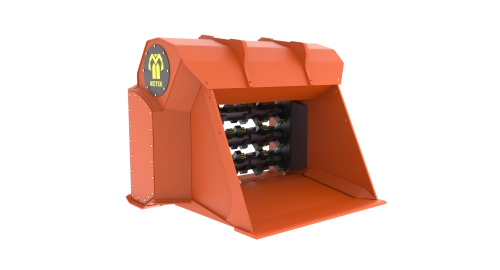
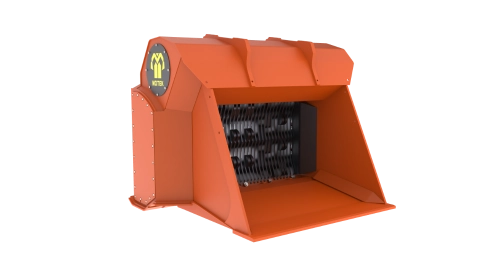
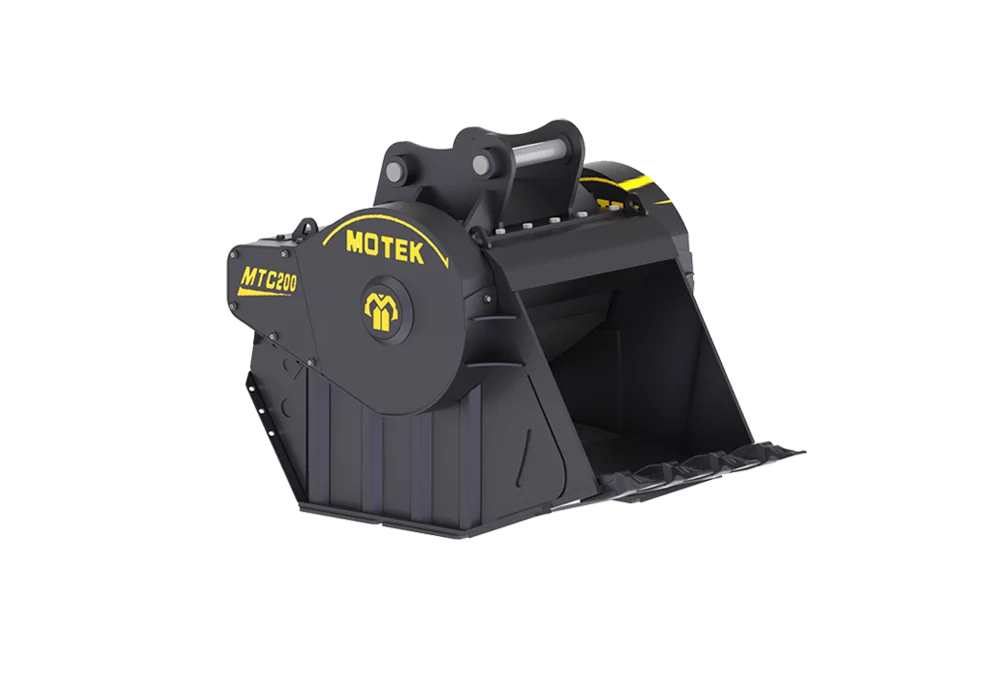
Excavator screening buckets have become highly practical attachments in earthmoving, building demolition, landscaping, and mining auxiliary operations. They not only complete excavation tasks but also simultaneously perform screening during operation, quickly separating soil, rock, and debris, improving on-site processing efficiency. For projects requiring reduced secondary handling and manual screening, screening buckets offer a more time-saving and labor-saving solution.
What scenarios are suitable for excavator screening buckets?
Screening buckets are particularly suitable for handling mixed materials, such as soil layers containing stones, tree roots, bricks, and concrete debris. They are also suitable for soil preparation before backfilling, construction waste recycling, and landscaping soil sorting. Compared to ordinary buckets, they excel at “digging and screening simultaneously,” retaining usable fine materials while promptly separating large particles, reducing subsequent cleaning and manual sorting workload.
Why are screening buckets more efficient than ordinary buckets?
Ordinary buckets can only perform digging and loading, while soil sifting bucket has an internal screening structure that allows for material separation directly on-site. This eliminates the need for users to transport all excavated soil and gravel back to the site for further processing; preliminary screening can be completed on-site. For projects with tight schedules and limited space, this approach not only improves efficiency but also reduces transportation and labor costs.
What parameters should be considered when selecting a screening bucket?
The key considerations for selecting a screening bucket typically include screen aperture size, bucket material, wear resistance, and compatibility with the excavator’s tonnage. Screen apertures that are too large allow fine materials to escape easily; screen apertures that are too small reduce processing speed. Therefore, the selection must be based on the type of material. For example, for soil screening, a finer screen can be chosen; if there is a lot of rock and debris, a structural design with stronger wear resistance and better maneuverability should be prioritized. Simultaneously, the screening bucket must be matched with the excavator’s tonnage to ensure stability and operational efficiency.
Which screening bucket is more suitable for your excavator?
For small to medium-sized projects, it is recommended to choose a compact and flexible screening bucket; for mining, demolition, and large-scale earthmoving projects, models with larger bucket capacity and higher strength are more suitable. Different projects have different processing capacity requirements; price should not be the sole consideration, but rather the actual material condition and operational objectives. Choosing the right screening bucket is crucial to maximizing the equipment’s value.
What are the advantages of screening buckets in actual construction?
Overall, the advantages of gravel screening buckets are mainly reflected in improved efficiency, reduced labor, lower transportation costs, and increased material utilization. They help construction companies separate soil, rock, and debris more quickly, making them particularly suitable for projects with high on-site processing requirements. For users looking to improve construction efficiency, optimize resource recovery, and reduce on-site material stockpiling, screening buckets are excavator attachments worth considering.
Excavator screening buckets suitable for soil, rock, and debris can help users improve sorting efficiency, reduce labor costs, and minimize secondary transportation under various working conditions. For construction sites requiring efficient processing of mixed materials, choosing the right screening bucket can not only optimize the construction process but also enhance resource recovery value. In the future, MOTEK will focus more on helping users find more efficient and durable screening solutions based on different material characteristics and construction needs.
Author

Jack Liu
MOTEK General Manager 20 years of experience in construction machinery. Former agent for several high-end European attachment brands. A visionary leader driving MOTEK's growth.

