

Different Types of Motek Crushing Buckets for Heavy Machinery
Release time: 2026-04-30
Traditional crushing operations rely on fixed stations or long-distance transport—methods characterized by high costs and limited mobility—making it difficult to meet the urgent modern engineering demands for on-site resource utilization and operational flexibility. As a revolutionary attachment for host machines such as excavators, Motek crushing buckets bring the “crushing” function directly to the operational front lines, achieving a seamless integration of “excavation, crushing, and loading.” They serve as a key enabling tool for promoting the on-site recycling and reuse of construction waste, mining spoil, and similar materials, thereby driving cost reduction, efficiency gains, and a green transition within the industry.
Table of Contents
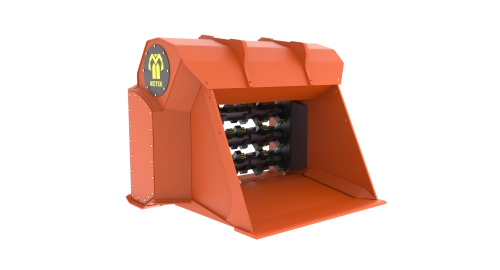
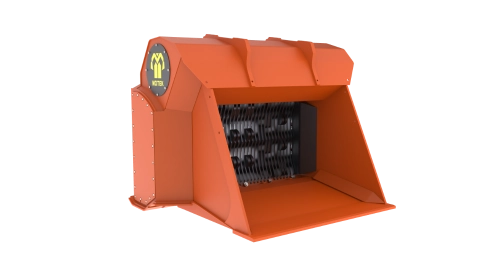
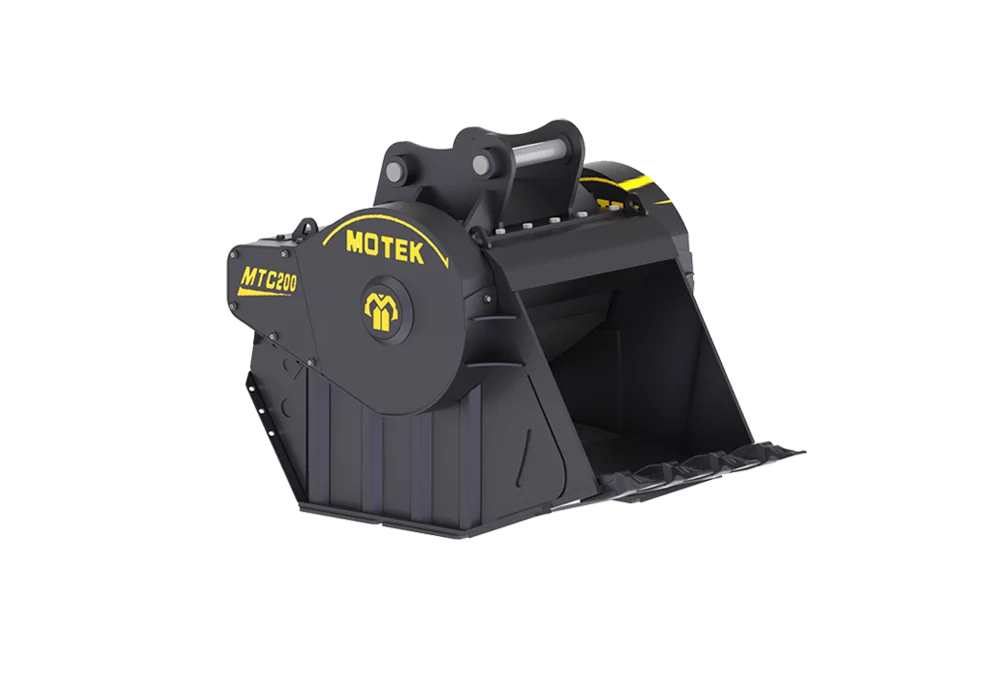
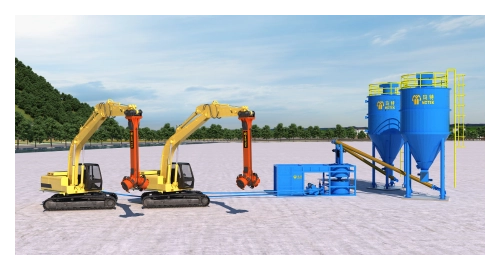
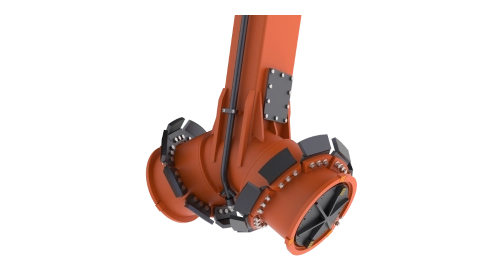
Essentially, a crusher bucket is an integrated hydraulic crushing unit that mounts directly onto an excavator’s boom or replaces its standard bucket, drawing power from the excavator’s own hydraulic system. Internally, it is typically equipped with either a jaw crushing chamber (for coarse crushing) or a hammer-type crushing rotor (for medium to fine crushing), both driven by hydraulic motors. During operation, the operator uses the bucket just like a standard one—”scooping up” large blocks of concrete, rock, ore, or similar materials—which are then instantly crushed within the bucket’s enclosed chamber. The resulting crushed aggregates are subsequently discharged directly into transport vehicles or utilized immediately for subsequent applications. This entire process realizes a fully integrated “excavation—crushing—loading” workflow.
Core Application Needs and Diverse Scenarios
On-Site Recycling and Resource Utilization of Construction Waste: This constitutes the most widespread application for crushing buckets. At sites involving urban renewal or building demolition, massive quantities of concrete blocks, bricks, tiles, and asphalt chunks no longer require off-site transport; instead, they are processed directly by the crushing bucket into recycled aggregates of various grain sizes (e.g., 0–30 mm, 30–80 mm). These aggregates can be utilized on-site for roadbed backfilling, site leveling, or as raw materials for brick manufacturing, thereby establishing a closed-loop system of “demolition—recycling—utilization.” This approach can save up to 30%–50% on waste removal and landfill disposal costs while simultaneously generating revenue through the sale of the processed materials.
Bench Crushing and Pre-Screening in Mines and Quarries: In mining operations, the large blocks of rock generated by blasting often require secondary crushing. Crusher buckets can be mounted directly onto excavators to perform primary crushing of oversized ore blocks right at the mining bench. By reducing the material to a size suitable for feeders or conveyor belts, they significantly boost the efficiency of downstream primary crushing stations and minimize blockages. This solution is particularly well-suited for mining areas with complex terrain where the installation of fixed equipment is impractical.
Tunneling and Hydraulic Structure Spoil Processing: Transporting rock spoil (rock and concrete) generated during tunnel excavation and hydraulic culvert construction presents a significant challenge. Crusher buckets enable immediate crushing—either inside the tunnel or at its entrance—converting the spoil into compliant sand and gravel aggregates. These materials can then be used directly for tunnel lining, roadbed filling, or commercial sale. This approach completely resolves the logistical and environmental regulatory hurdles associated with transporting spoil off-site, making the crusher bucket a critical piece of equipment for “Green Tunnel” projects.
Emergency Response and Specialized Demolition: In emergency road repairs (such as clearing rockfalls or collapsed structures) and post-disaster debris management, operations often take place in confined spaces under tight time constraints. The inherent mobility of the crusher bucket allows for rapid deployment to the site, enabling the crushing of obstacles and the clearing of access routes. In scenarios requiring “protective demolition”—where specific structural elements must be preserved—the crusher bucket offers precise control over particle size, providing a safer and more accurate alternative to explosive demolition.
Landscaping and Municipal Stone Processing: These units are utilized for processing landscaping stone, crushing riverbed pebbles following dredging operations, and recycling asphalt concrete during municipal road maintenance. They facilitate the localized, small-scale, and decentralized processing of stone materials and waste products.
Irreplaceable Advantages Over Traditional Methods
Exceptional Mobility and Site Adaptability: “Dig-and-go” capability requires no fixed infrastructure, making it ideal for dispersed, confined, or temporary work sites.
Significant Comprehensive Economic Benefits: Drastically reduces transportation costs, landfill taxes, and expenses for purchasing external aggregates, effectively turning waste into valuable resources.
Environmental Compliance and Social Benefits: Minimizes airborne dust generated during transport, reduces traffic congestion, and decreases the volume of waste sent to landfills, thereby aligning with circular economy principles and sustainable development policies.
Streamlined Operations and Enhanced Efficiency: Reduces the number of material handling stages, shortens construction timelines, and decreases reliance on manual labor.
Key Factors in Selection and Performance
Selecting the appropriate rock crusher bucket requires careful alignment with the excavator’s tonnage, as well as its hydraulic flow and pressure specifications. Furthermore, the choice of jaw plate or hammer head type—along with the grate opening size—must be tailored to the specific primary material being processed (e.g., concrete, rock, or ore) and the desired output particle size. Optimal performance hinges on the operator’s proficiency, the moisture content and hardness of the material, and the proper configuration of operational parameters.
The crushing bucket has evolved beyond being a mere tool; it now serves as a pivotal hub on the construction site for establishing a closed-loop material cycle and generating incremental value. Through its exceptional mobility and advanced material recycling capabilities, it fundamentally redefines both the operational logic and the economic model of the “crushing” process. In this transformative journey, Anhui Motek stands as a vital technical partner and equipment supplier, empowering global engineering projects to transition toward leaner, more sustainable operational models through its specialized range of crushing bucket products and solutions designed for diverse working conditions.