

What are the main uses for a crusher bucket?
Release time: 2026-03-12
Table of Contents
In today’s fast-paced construction and demolition sectors, operational efficiency and cost reduction are paramount. Heavy machinery attachments have evolved to meet these demands, and few tools are as transformative as the crusher bucket.
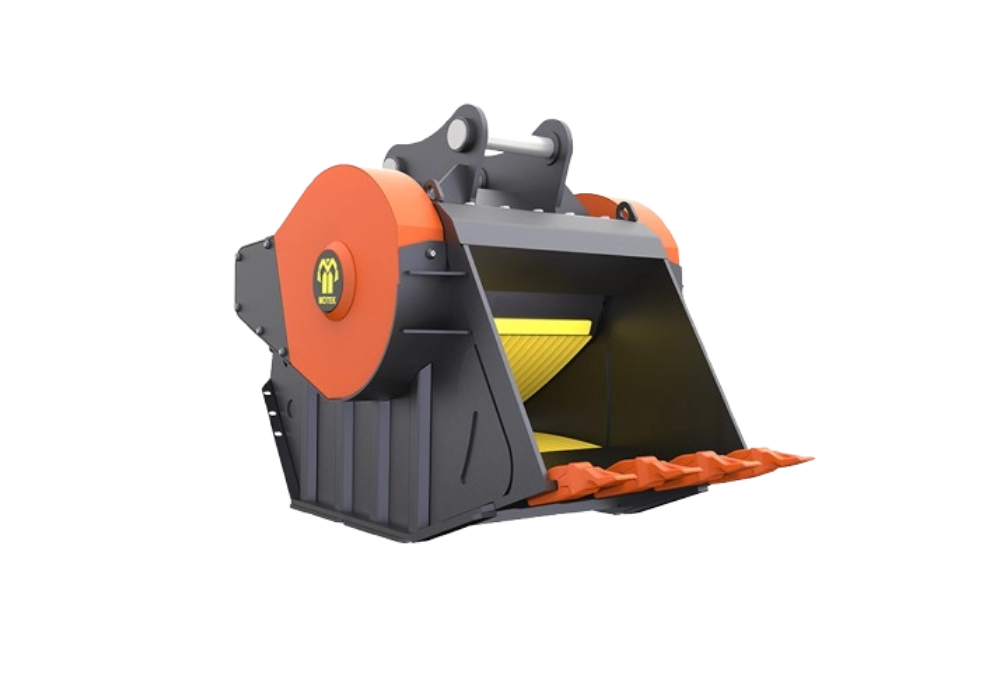
By turning an excavator, skid steer, or wheel loader into a highly mobile, on-site jaw crusher, this attachment eliminates the bottleneck of material handling. Instead of relying on expensive stationary crushing plants or outsourcing waste disposal, operators can scoop, crush, and repurpose heavy materials directly where they stand.
But what exactly are the main uses for a crusher bucket, and how can integrating a top-tier model—like those engineered by MOTEK—into your fleet improve your project’s bottom line? Let’s explore the primary applications of this powerful heavy machinery attachment.
1. On-Site Demolition and Construction Waste Recycling
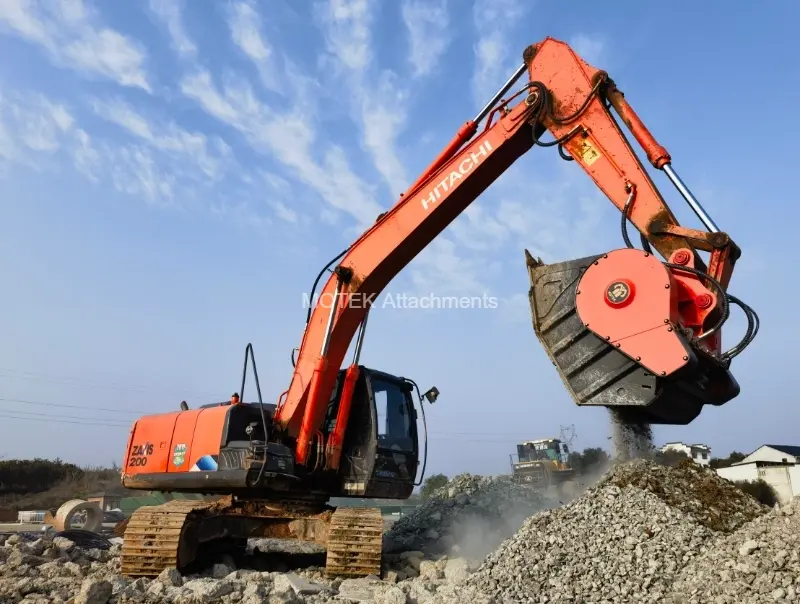
The single most common and lucrative application for a crusher bucket is in the demolition sector. When buildings, bridges, or concrete structures are brought down, the resulting debris poses a massive logistical challenge.
- Turning Waste into Aggregate: A crusher bucket allows operators to scoop up demolition rubble and crush it down to a specific, reusable output size. Industry-leading attachments, such as the MOTEK crusher bucket, feature the largest opening widths in their class, ensuring high-yield output even with bulky concrete debris.
- Cost Elimination: By crushing material on-site, contractors eliminate the exorbitant costs of hauling heavy waste to a landfill, paying dumping fees, and simultaneously buying new gravel or crushed stone for the next phase of construction.
- Consistent Output: Advanced buckets ensure that even if the internal jaw plates wear down over time, the shape and size of the output remain perfectly consistent with the contractor’s demands.
2. Pipeline Work and Trench Backfilling
Laying pipelines, whether for water, sewer, or telecommunications, requires extensive trenching. Traditionally, the hard rock and rocky soil excavated from the trench are hauled away, and specialized backfill material is trucked in to cover the pipes safely.
Crusher buckets revolutionize this workflow. Operators can take the excavated rocky spoil, crush it down to a fine, uniform consistency, and immediately deposit it back into the trench as protective backfill. This closed-loop process speeds up pipe-laying operations, reduces truck traffic on narrow utility sites, and drastically cuts material procurement costs.
3. Road Construction and Maintenance
Roadway infrastructure projects demand massive volumes of aggregate for sub-base and base layers. Crusher buckets are frequently deployed in both the creation of new roads and the maintenance of existing ones.
- Repurposing Asphalt: When old asphalt is milled or excavated, it can be processed through a crusher bucket to become an excellent, highly compactable sub-base for the new road surface.
- Remote Road Building: For forestry or mining roads in remote locations, hauling in commercial aggregate is cost-prohibitive. An excavator equipped with a crusher bucket can simply crush the natural rock found along the right-of-way, creating a durable road surface using 100% local materials.
4. Mining and Quarrying Operations
While large-scale mining relies on massive, stationary primary crushers, crusher buckets play a vital supporting role in the quarrying industry.
- Secondary Crushing: They are ideal for secondary or tertiary crushing tasks, helping to size down oversized boulders rejected by the primary plant.
- Confined Spaces: In smaller quarries or underground mining operations where space is too restricted to set up a full crushing plant, an excavator-mounted crusher bucket provides a flexible, mobile solution to process raw stone and ores. Premium models from MOTEK are specifically designed to operate efficiently with a single excavator pump (without needing dual pump confluence), making them highly adaptable in rugged quarry environments.
5. Land Clearing and Commercial Site Preparation
Before any new commercial or residential development can begin, the site must be leveled and prepped. In regions with rocky terrain, this often means dealing with large natural boulders and rocky outcroppings.
Instead of blasting or using hydraulic breakers and hauling the oversized rocks away, a crusher bucket can break down the natural terrain. The resulting crushed stone can then be used immediately to level the site, build temporary access roads for construction vehicles, or stabilize muddy ground.
The ROI: Why Contractors Invest in Mobile Crushing
Understanding the uses of a crusher bucket highlights exactly why they offer such a rapid Return on Investment (ROI). The benefits extend far beyond simple material processing, especially when utilizing expertly engineered attachments:
- System Protection: High-quality buckets utilize belt-driven systems to absorb and reduce the crushing vibration, protecting the excavator’s main hydraulic system from long-term damage.
- Drastic Reduction in Transport Costs: Eliminates the need for a fleet of dump trucks moving waste out and new aggregate in.
- Continuous Operation: Efficient hydraulic designs ensure the excavator does not overheat, even during high-intensity, continuous operations in harsh summer temperatures.
- Environmental Sustainability: Recycling demolition waste and repurposing local rock significantly lowers the carbon footprint of a construction project.
A Must-Have for Modern Fleets
From urban demolition sites to remote forestry roads, the main uses for a crusher bucket all center around one core advantage: material independence. By enabling contractors to process, recycle, and reuse aggregate on-site, attachments like the MOTEK crusher bucket transform a major project expense into an operational advantage. For any company looking to streamline their earthmoving or demolition operations, investing in a reliable crusher bucket is the key to staying competitive.
Author

Gershon Zhou
MOTEK R&D Director With 18 years of focused experience in the construction machinery attachment industry. As a National Certified Senior Engineer, he is a well-recognized technical leader in the field of earthmoving machine attachments.